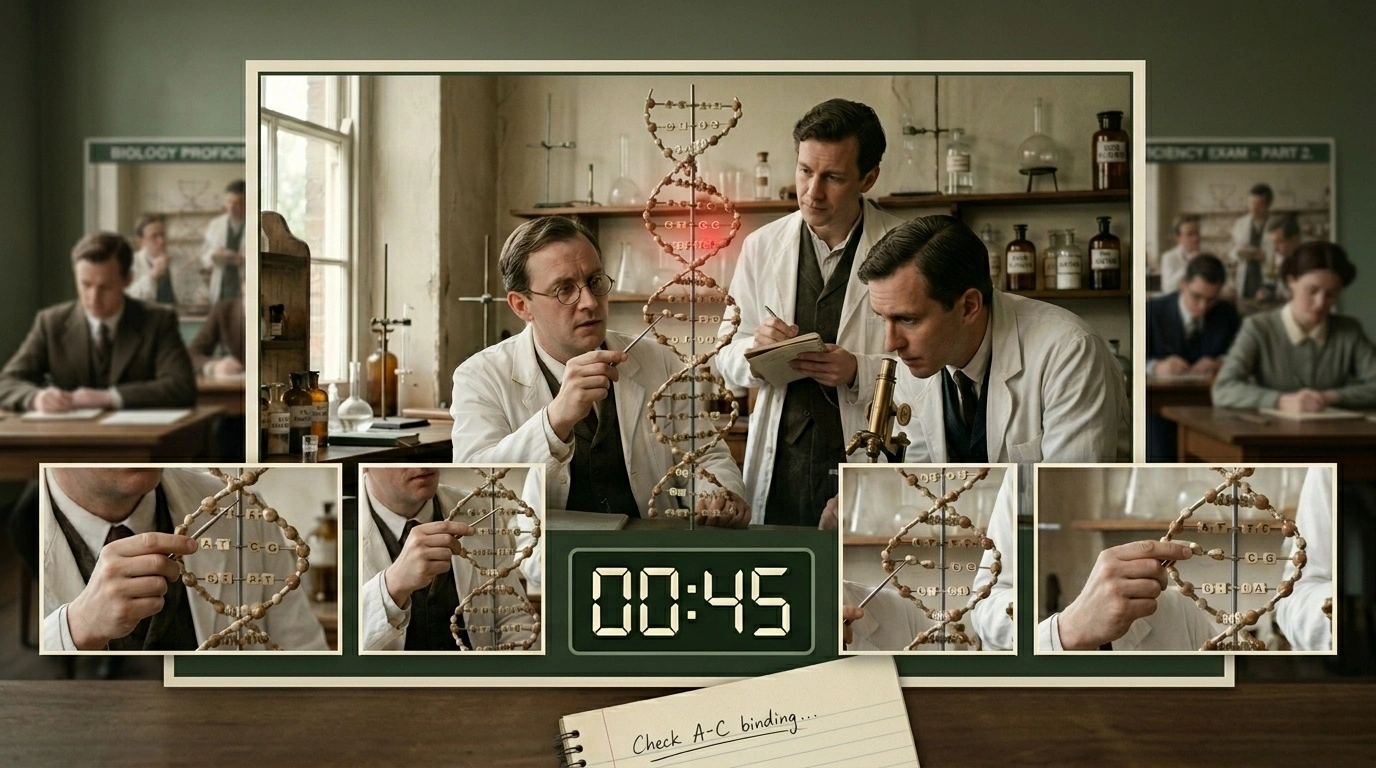
Discovery of Nucleic Acids Quiz: A Medical Entrance Challenge
Q&A: Discovery of Nucleic Acids
Who discovered nucleic acids and when?
In 1869, Swiss biochemist Friedrich Miescher made a groundbreaking discovery while studying white blood cells from pus-soaked bandages. He isolated a phosphorus-rich substance from cell nuclei, which he named ‘nuclein.’ This marked the first identification of what we now know as nucleic acids. However, their true importance wasn’t understood until decades later. Researchers eventually uncovered their role in heredity.
Why are nucleic acids essential for life?
Nucleic acids serve as the molecular blueprints for all living organisms. DNA stores genetic instructions in its sequence of bases. Various RNA molecules then translate this information into proteins. These processes enable cells to function, grow, and reproduce. Without nucleic acids, genetic inheritance and cellular operations would be impossible. This makes them fundamental to all known life forms.
How did Rosalind Franklin contribute to DNA research?
British scientist Rosalind Franklin produced crucial X-ray diffraction images of DNA fibers in the early 1950s. Her famous “Photo 51” revealed key structural details, including the helical pattern and dimensions of DNA. Although scientists initially overshadowed her work, it provided critical evidence for the double-helix model that Watson and Crick proposed in 1953, revolutionizing molecular biology.
What tools did early scientists use to study nucleic acids?
Pioneering researchers employed crude but innovative methods: Miescher used salt solutions to precipitate nuclein from cell extracts. Later scientists utilized UV absorption to quantify nucleic acids. The field advanced dramatically with X-ray crystallography in the 1950s, electron microscopy in the 1960s, and today’s next-generation sequencing technologies that allow entire genomes to be read rapidly.
What is the historical significance of Avery, MacLeod, and McCarty’s experiment?
In 1944, Oswald Avery, Colin MacLeod, and Maclyn McCarty provided strong evidence that DNA—not proteins or carbohydrates—was the substance responsible for genetic transformation in bacteria. Using Streptococcus pneumoniae, they showed that DNA from virulent strains could genetically transform non-virulent strains. This experiment laid the foundation for modern molecular genetics by identifying DNA as the hereditary molecule.
When was the double-helix structure of DNA discovered and why was it important?
James Watson and Francis Crick discovered the double-helix model of DNA in 1953, using key insights from Rosalind Franklin’s X-ray images. This discovery was vital because it explained how DNA replicates and carries genetic information. Scientists discovered that complementary base pairing (A with T, G with C) preserves and transmits genetic information, revolutionizing biology, genetics, and biotechnology.
How did nucleic acid research lead to the Human Genome Project?
Decades of nucleic acid research, including the discovery of DNA’s structure and advances in sequencing techniques, culminated in the Human Genome Project (1990–2003). This international initiative successfully mapped all 3 billion base pairs of human DNA. It marked a turning point in biology and medicine, enabling breakthroughs in personalized medicine, genetic testing, and our understanding of complex diseases.