
The Dark Genome: How Non-Coding DNA Influences Human Health
Introduction
The dark genome is one of the most important frontiers in modern genetics. Although the human genome contains approximately 3.2 billion DNA base pairs, only around 1–2% directly encode proteins. For decades, scientists considered much of the remaining DNA biologically unimportant and often described it as junk DNA. However, advances in genomics and molecular biology have fundamentally changed this perspective. Researchers now recognize that many non-coding regions participate in gene regulation, RNA processing, chromatin organization and other essential biological processes.
The dark genome encompasses a diverse collection of genomic elements, including promoters, enhancers, introns, non-coding RNA genes, repetitive sequences and structural regions. Some have well-established biological functions, while others remain poorly characterized. Importantly, not every non-coding sequence is functional, and biochemical activity alone does not establish a physiological role.
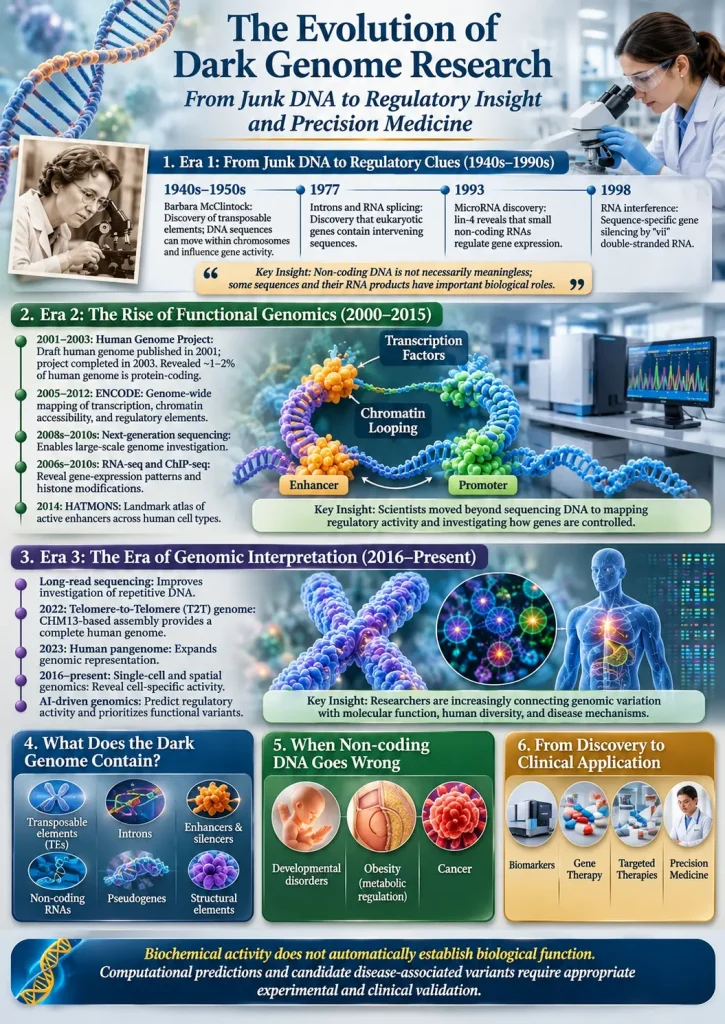
The evolution of dark genome research reflects a remarkable scientific journey—from the early discovery of mobile genetic elements to modern functional genomics, comprehensive genome mapping and precision medicine.The infographic The Evolution of Dark Genome Research: From Junk DNA to Regulatory Insight and Precision Medicineprovides a visual overview of these major discoveries, technological advances and emerging clinical applications.
Genetic variations outside protein-coding regions can influence gene expression, disrupt development and contribute to inherited disorders, cancer and complex diseases. Understanding these regions is therefore essential for moving beyond a protein-centred view of genetics towards a more complete understanding of how genomic variation influences human health.
The Evolution of Dark Genome Research
Our understanding of the dark genome has evolved dramatically, from considering non-coding DNA as “junk DNA” to recognizing its essential roles in gene regulation, cellular function and human disease. The infographic below highlights key scientific milestones, major discoveries and emerging clinical applications that have transformed modern genomics.
What Does the Dark Genome Actually Include?
The dark genome is not a single biological structure. It describes a broad and diverse part of the genome that includes non-protein-coding sequences and their associated regulatory elements. Researchers should distinguish three categories:
- Non-coding DNA: DNA sequences that do not directly encode proteins.
- Functionally characterized non-coding DNA: Sequences with experimentally supported biological roles.
- Uncharacterized DNA: Regions whose biological significance remains uncertain.
These categories are not interchangeable. A promoter with a demonstrated role in transcription is different from an intergenic region that produces a biochemical signal in one experiment but has no established physiological function.
There is also a narrower use of the term dark genome. Some researchers use it for genomic regions that short-read sequencing technologies cannot reliably sequence, align or assemble. These regions often contain repetitive sequences or complex structural arrangements. Ryan and Corvin (2023), for example, examined such difficult-to-analyse regions and their consequences for disease-variant discovery. This article uses the broader meaning of the dark genome while recognizing that sequencing-inaccessible regions represent a separate technical challenge.
Major Components of the Non-Coding Genome
Non-coding DNA contains several elements that influence gene expression, RNA processing and chromosome organization.
Promoters
Promoters are DNA regions located near transcription start sites. They recruit transcription factors and other proteins required to initiate RNA synthesis. Changes in promoter sequences can alter transcription-factor binding and modify the amount of RNA produced by a gene.
For example, a variant may weaken an activator-binding site and reduce gene expression. However, the effect depends on the regulatory context, including the cell type, developmental stage and availability of transcription factors.
Enhancers
Enhancers increase the transcription of target genes. They can act upstream, downstream or within introns, and their regulatory targets may lie far from their genomic location. Their activity often depends on tissue and developmental context.
Chromatin folding can bring an enhancer into physical proximity with a target promoter. A genetic variant within an enhancer may therefore change gene expression without altering the protein-coding sequence of the affected gene. Identifying the correct target is not always straightforward because an enhancer may contact more than one promoter.
Silencers and Insulators
Silencers reduce transcription by recruiting repressive regulatory proteins or influencing chromatin structure. Insulators help organize regulatory boundaries and can restrict inappropriate enhancer–promoter interactions.
The protein CTCF contributes to many chromatin-boundary functions, often working with cohesin. Changes in these regulatory regions may allow an enhancer to interact with an unintended gene. Such disruption can alter gene expression even when the coding sequence remains unchanged.
Introns
Introns are removed from precursor messenger RNA (pre-mRNA) during RNA splicing. However, they are not simply inactive intervals between exons. They can contain enhancers, splice-regulatory sequences and binding sites for RNA-associated proteins.
Intronic variants may disrupt normal splice-site recognition. This can cause exon skipping, intron retention or activation of cryptic splice sites. The resulting transcript may encode an altered protein, become unstable or undergo degradation before translation.
Non-Coding RNA Genes
Some genomic regions produce functional RNA molecules rather than protein templates. These non-coding RNAs include:
- MicroRNAs (miRNAs): Regulate target messenger RNA stability and translation.
- Long non-coding RNAs (lncRNAs): Can influence transcription, chromatin organization and RNA processing.
- Small nuclear RNAs (snRNAs): Participate in spliceosome function.
- Small nucleolar RNAs (snoRNAs): Help modify ribosomal RNA and other RNA molecules.
The functions of many annotated non-coding RNAs remain uncertain. Their expression or computational annotation alone does not prove that they have an important biological role.
Repetitive DNA and Transposable Elements
A substantial proportion of the human genome consists of repetitive sequences, including transposable elements and their remnants. These sequences have contributed to genome evolution and, in some cases, supplied material for new regulatory elements.
However, transposable elements can also disrupt genes or regulatory regions when they insert into new genomic locations. Their effects depend on the element, its genomic position and the cell type in which it acts.
Structural Elements
Some non-coding regions contribute directly to chromosome organization and stability.
- Telomeres protect chromosome ends from degradation and inappropriate fusion.
- Centromeres help organize chromosome segregation during cell division.
Although these regions do not encode conventional proteins, they are essential for maintaining chromosome integrity and the accurate distribution of genetic material.
The following table 1 summarizes the major components of the non-coding genome, their principal functions, and the potential biological consequences of their dysfunction.
| Table 1: Major Non-Coding Genomic Elements: Regulatory Functions and Potential Biological Consequences | ||
| Component | Main role | Potential biological consequence |
| Promoters | Initiate transcription | Altered gene-expression levels |
| Enhancers | Increase target-gene expression | Developmental or metabolic changes |
| Silencers | Repress transcription | Abnormal gene activation |
| Insulators | Organize regulatory boundaries | Inappropriate enhancer–promoter interactions |
| Introns | Support splicing and regulation | Abnormal RNA processing |
| MicroRNAs | Regulate mRNA stability and translation | Disturbed gene-expression networks |
| Long non-coding RNAs | Influence chromatin and transcription | Context-dependent regulatory effects |
| Transposable elements | Repetitive genomic sequences | Genome evolution or instability |
| Telomeres | Protect chromosome ends | Chromosome instability |
| Centromeres | Support chromosome segregation | Abnormal chromosome distribution |
How Non-Coding DNA Regulates Gene Expression
Gene expression involves several coordinated molecular processes. Non-coding DNA influences many of these processes, helping determine when, where and how strongly genes are expressed.
Transcription-Factor Binding
Transcription factors recognize specific DNA sequences in promoters, enhancers and other regulatory elements. A single nucleotide substitution can strengthen or weaken a binding site. This may change the probability that transcription begins.
The outcome depends on the surrounding regulatory environment. A variant may influence gene expression in one cell type but have little or no measurable effect in another.
Chromatin Structure and Epigenetic Regulation
DNA is packaged around histone proteins to form nucleosomes. These structures contribute to chromatin organization and influence access to regulatory sequences.
Open chromatin generally allows transcription factors and regulatory proteins to reach DNA more easily. Compact chromatin tends to restrict access. DNA methylation and histone modifications can influence these states and contribute to the regulation of gene activity.
Consequently, a non-coding variant may affect gene expression by changing a regulatory-protein binding site or by influencing the local chromatin environment.
Three-Dimensional Genome Organization
The genome is not arranged as a straight, extended DNA molecule inside the nucleus. It folds into a complex three-dimensional structure that brings distant genomic regions into physical proximity.
Chromatin loops can connect enhancers with promoters. Topologically associating domains (TADs) define regions in which DNA sequences interact more frequently with one another than with sequences outside those regions. CTCF and cohesin contribute to the formation and maintenance of many of these structures.
Disruption of a regulatory boundary may allow an enhancer to contact an unintended promoter. This mechanism is particularly important during embryonic development, when precise control of gene expression determines tissue formation and organ development.
However, physical contact does not automatically prove functional regulation. Researchers must combine chromatin-interaction data with gene-expression analysis and functional experiments.
RNA Processing and Post-Transcriptional Regulation
Non-coding sequences also influence gene expression after transcription. Intronic signals guide RNA splicing, while regulatory RNAs can affect transcript stability and translation.
For example, a variant near a splice site may cause an exon to be removed incorrectly. Similarly, a change in a microRNA-binding site may alter the regulation of a target messenger RNA. These mechanisms demonstrate that the biological consequences of non-coding variation can extend beyond transcription itself.
How Non-Coding Variants Contribute to Human Disease
A genetic variant does not need to alter a protein sequence to affect human health. Changes in non-coding DNA can modify the amount, timing or location of gene expression. These effects may disturb normal development, metabolism or tissue function.
Several mechanisms are particularly important:
- Altered gene expression: Promoter and enhancer variants can increase or reduce the expression of developmental, metabolic or disease-associated genes.
- Abnormal RNA splicing: Intronic variants can disrupt splice-site recognition and produce abnormal transcripts.
- Disrupted chromatin organization: Changes affecting regulatory boundaries may alter enhancer–promoter interactions.
- Altered non-coding RNA activity: Variants may influence RNA molecules involved in gene regulation.
- Chromosome instability: Changes affecting telomeres, centromeres or other structural regions can compromise chromosome integrity.
The following examples demonstrate how researchers have connected non-coding variation with specific biological mechanisms.
The SHH–ZRS Enhancer and Limb Development
The SHH gene encodes Sonic Hedgehog, a signalling protein that plays an important role in embryonic patterning. During limb development, a distant enhancer known as the zone of polarizing activity regulatory sequence (ZRS) controls SHHexpression.
Lettice and colleagues (2003) demonstrated that the ZRS lies within an intron of the neighbouring LMBR1 gene, approximately 1 megabase from SHH. Mutations in this regulatory element were associated with preaxial polydactyly, a congenital condition characterized by additional digits.
These variants can cause abnormal SHH expression in developing limb tissue. The example illustrates why researchers cannot always identify the biological target of a non-coding variant by selecting the nearest gene. A regulatory sequence may influence a distant developmental gene through long-range chromatin interactions.
The FTO–IRX3 Region and Obesity Risk
The FTO locus provides one of the most informative examples of non-coding variation influencing a complex human trait.
Common variants within introns of FTO are strongly associated with obesity risk. Initially, researchers considered whether these variants affected obesity through FTO itself. However, Smemo and colleagues (2014) identified long-range regulatory connections between the obesity-associated region within FTO and the promoter of IRX3, a homeobox gene.
Their study reported that obesity-associated variants were associated with IRX3 expression, but not FTO expression, in human brain tissue. The researchers also found that Irx3-deficient mice had approximately 25–30% lower body weight, primarily because of reduced fat mass and increased energy expenditure.
A subsequent study by Claussnitzer and colleagues (2015) provided additional mechanistic evidence. They showed that the obesity-associated rs1421085 variant disrupts a binding motif for the ARID5B repressor in human adipocyte precursor cells. This change increases enhancer activity and raises IRX3 and IRX5 expression during early adipocyte differentiation. The resulting changes influence the balance between energy-storing white adipocytes and thermogenic beige adipocytes.
Together, these studies demonstrate how a non-coding variant can influence a gene located elsewhere in the genome and affect a complex trait through tissue-specific regulatory mechanisms. They do not imply that a single variant determines obesity. Body weight reflects interactions among many genetic, environmental, behavioural and metabolic factors.
TERT Promoter Mutations in Melanoma
The TERT gene encodes the catalytic component of telomerase, an enzyme involved in maintaining telomere length. Recurrent mutations in the TERT promoter have been identified in melanoma.
Horn and colleagues (2013) and Huang and colleagues (2013) showed that these promoter mutations can create new transcription-factor binding sites and increase TERT expression. Increased telomerase activity can support telomere maintenance and continued cellular proliferation.
This example demonstrates how a small change in a non-coding regulatory sequence can contribute to cancer development without altering the protein-coding sequence of the affected gene.
Non-Coding Variants in Rare Inherited Disorders
Non-coding variants also matter in rare genetic conditions. Disease-associated changes may occur in enhancers, promoters, deep intronic regions or other regulatory sequences. Such variants can disturb developmental gene expression or alter RNA processing.
For families in whom routine genetic testing fails to identify a convincing coding variant, non-coding variation may represent one possible explanation. However, finding a rare variant outside an exon does not establish that it causes disease. Researchers must evaluate the inheritance pattern, clinical phenotype, population frequency, regulatory context and functional evidence.
Why Genome-Wide Association Studies Identify So Many Non-Coding Variants
Genome-wide association studies (GWAS) compare genetic variation across large groups of individuals to identify variants associated with diseases or measurable traits. Many GWAS signals occur outside protein-coding regions.
This observation is important, but it requires careful interpretation. A GWAS identifies a statistical association; it does not automatically identify the causal variant or the biological mechanism.
Nearby variants may be inherited together because of linkage disequilibrium. Consequently, several variants in the same genomic region may show similar statistical associations, even when only one—or a combination of them—directly contributes to the trait.
A systematic review by Alsheikh and colleagues (2022) identified 309 experimentally validated non-coding GWAS variants associated with 130 human disease traits and linked to the regulation of 252 genes. The review also documented different approaches used to validate regulatory effects, including gene-expression analysis, transcription-factor binding assays, reporter experiments, animal models and genome editing.
Non-coding variants are often more difficult to interpret than coding variants. A coding variant may cause a premature stop codon or change an amino acid. In contrast, a non-coding variant requires researchers to investigate several questions:
- Does it overlap a regulatory element?
- Does it alter transcription-factor binding or chromatin accessibility?
- Which gene does the affected region regulate?
- Is the effect specific to a particular tissue or developmental stage?
- Does experimental evidence support a disease-related mechanism?
Computational predictions can help prioritize candidate variants, but they cannot replace functional validation.
How Scientists Study the Dark Genome
Understanding non-coding DNA requires more than sequencing. Researchers combine genome analysis, gene-expression studies, chromatin profiling and functional experiments.
Whole-Genome Sequencing
Whole-genome sequencing (WGS) examines DNA across nearly the entire genome. It can identify variants in coding and non-coding regions, including promoters, enhancers, introns and intergenic sequences.
WGS is particularly useful when researchers suspect a disease-associated variant lies outside the regions examined by whole-exome sequencing. However, WGS does not establish the biological function of every detected variant. Repetitive and structurally complex regions may also remain difficult to analyse, depending on the sequencing technology and analysis pipeline.
RNA Sequencing
RNA sequencing (RNA-seq) measures RNA molecules expressed in a biological sample. It can reveal changes in gene expression, abnormal splicing and differences in transcript abundance.
Its usefulness depends on tissue selection. A regulatory variant may act only in a particular cell type or developmental stage. Blood RNA, for example, may not reveal an expression change that occurs only in developing neural tissue.
ATAC-seq and DNase-seq
ATAC-seq and DNase-seq identify regions of accessible chromatin. Researchers use these methods to locate candidate promoters, enhancers and other regulatory elements.
However, accessibility does not prove that a region regulates a particular gene. Additional evidence is needed to establish its function and target.
ChIP-seq
Chromatin immunoprecipitation followed by sequencing (ChIP-seq) maps the binding of selected proteins to DNA. Researchers can use it to investigate transcription-factor binding and histone modifications associated with different chromatin states.
The results depend on antibody quality, experimental design and the biological material examined. A detected chromatin mark should not be treated as definitive proof of regulatory function.
Hi-C and Chromatin-Interaction Methods
Hi-C and related methods investigate three-dimensional chromatin organization. They help identify chromatin domains, loops and physical interactions between genomic regions.
These data can help researchers identify potential enhancer–promoter relationships. Nevertheless, physical contact does not necessarily mean that one region functionally regulates the other.
CRISPRi, CRISPRa and Genome Editing
CRISPR-based methods allow researchers to test candidate regulatory regions. CRISPR interference (CRISPRi) can repress selected sequences, while CRISPR activation (CRISPRa) can increase their regulatory activity without requiring conventional DNA cleavage.
Researchers can also use genome editing to introduce or correct specific variants. Measuring the resulting changes in gene expression or cellular behaviour provides stronger evidence of function than computational prediction alone.
Massively Parallel Reporter Assays
Massively parallel reporter assays (MPRAs) test the regulatory potential of many DNA sequences simultaneously. They can compare alternative alleles and identify sequences that influence reporter-gene expression.
However, these assays often remove candidate sequences from their native genomic environment. They may therefore fail to reproduce chromatin organization, endogenous regulatory interactions or long-range effects. The following table 2 summarizes the major approaches, their investigative applications, and their principal limitations.
| Table 2: Major Genomic and Functional Assays for Investigating the Non-Coding Genome: Applications and Limitations | ||
| Method | What it investigates | Main limitation |
| WGS | Genome-wide sequence variation | Does not establish variant function |
| RNA-seq | Gene expression and RNA processing | Depends on sampled tissue and condition |
| ATAC-seq | Accessible chromatin | Accessibility does not prove regulatory activity |
| DNase-seq | Open chromatin regions | Requires functional corroboration |
| ChIP-seq | Protein binding and histone marks | Depends on antibody and experimental design |
| Hi-C | Three-dimensional chromatin interactions | Physical contact does not prove regulation |
| CRISPRi/CRISPRa | Effects of targeted regulatory perturbation | Results depend on model and cell type |
| MPRA | Regulatory activity of many sequences | May not reproduce native genomic context |
Functional Genomics, Bioinformatics and Artificial Intelligence
The growing volume of genomic data has made computational analysis essential. Researchers use bioinformatics to annotate regulatory elements, prioritize candidate variants and investigate potential gene-regulatory relationships.
The ENCODE project has mapped transcription, transcription-factor binding, chromatin accessibility and histone modifications across the human genome. Its findings revealed extensive biochemical activity across genomic regions. However, biochemical activity does not automatically establish evolutionary or physiological function. A DNA sequence may be transcribed or bind a protein without producing a meaningful biological effect.
The central question is therefore not simply whether a sequence is active. Researchers must determine what it does, where it acts and whether changing it produces a reproducible biological consequence.
The Genotype-Tissue Expression (GTEx) project provides another important resource. Its 2020 atlas analysed 15,201 RNA-sequencing samples from 49 tissues of 838 donors. These data help researchers identify expression quantitative trait loci (eQTLs), which are genetic variants associated with differences in gene expression.
An eQTL association can connect genetic variation with a possible regulatory effect. However, it does not always identify the causal variant or prove that altered expression causes disease.
Artificial intelligence and machine learning can further support non-coding variant interpretation. Deep-learning models can analyse DNA sequence patterns, predict regulatory activity and prioritize variants for experimental testing. Their performance depends on training data, cell-type representation and the genomic contexts included during model development.
Models may perform less reliably in populations or tissues that are poorly represented in their training datasets. AI predictions should therefore guide research rather than replace functional experiments or clinical evidence.
Why the Dark Genome Matters in Clinical Genetics
Many genetic diagnostic tests focus primarily on protein-coding regions. Whole-exome sequencing (WES) has identified numerous disease-causing variants, but it does not comprehensively examine the non-coding genome.
Some patients remain undiagnosed because their disease-associated variants lie outside the regions captured by exome sequencing. Possible explanations include deep intronic variants, regulatory variants, structural changes, repeat expansions or variants in genes and genomic regions that remain poorly characterized. To address these limitations, whole-genome sequencing (WGS) offers a broader approach by extending genomic analysis beyond protein-coding regions. Table 3 compares WES and WGS in terms of their genomic coverage, variant detection capabilities and interpretive limitations.
| Table 3: Whole-Exome Sequencing Versus Whole-Genome Sequencing | ||
| Feature | Whole-exome sequencing (WES) | Whole-genome sequencing (WGS) |
| Main target | Primarily protein-coding exons | Nearly the entire genome |
| Non-coding coverage | Limited and dependent on capture design | Broad, including regulatory and intergenic regions |
| Deep intronic variants | Generally not assessed comprehensively | More likely to be detected |
| Regulatory variants | Limited detection | Broader detection |
| Structural variation | Some variants may be detected, depending on pipeline | Broader assessment, but sensitivity varies |
| Repetitive regions | Often difficult to assess | Still challenging, particularly with short reads |
| Interpretation | Coding variants are often easier to prioritize | More variants require careful interpretation |
| Main limitation | Misses most non-coding regions | Higher analytical and interpretive demands |
WGS can broaden the search for disease-associated variation, but it does not automatically provide a molecular diagnosis. The functional significance of many non-coding variants remains uncertain.
A Practical Diagnostic Workflow
Consider a family with several affected children who show similar neurological features. WES identifies no convincing pathogenic coding variant, but the clinical findings and family history continue to suggest an inherited condition.
A broader investigation may involve the following steps:
- Reassess the clinical phenotype: Confirm the affected features, age of onset and possible inheritance pattern.
- Review the exome data: Check coverage, variant-calling quality, splice-region findings and the possibility of missed structural or technical variants.
- Consider WGS: Investigate variants in intronic, regulatory and intergenic regions, as well as structural variation.
- Prioritize candidate variants: Evaluate population frequency, segregation, predicted effect and consistency with the phenotype.
- Investigate regulatory evidence: Determine whether a candidate overlaps a promoter, enhancer, splice-regulatory element or other functional region.
- Assess gene expression or RNA processing: Use suitable tissue or cell models where feasible.
- Perform functional validation: Test whether the candidate variant changes gene expression, RNA processing or another relevant molecular process.
- Integrate clinical and molecular evidence: Determine whether the combined findings support a disease diagnosis.
This approach can help explain some previously unresolved cases. However, it does not guarantee a diagnosis. Relevant tissues may be inaccessible, candidate regulatory elements may be poorly characterized, and experimental findings may not fully reproduce the biological context in humans.
Why South Asian Genomic Representation Matters
The interpretation of non-coding variants also depends on the diversity of reference datasets. Many large genomic studies have historically included disproportionate numbers of individuals of European ancestry. This imbalance can limit the accuracy of variant-frequency estimates and computational predictions for underrepresented populations.
South Asia contains extensive genetic diversity shaped by population history, migration, endogamy and, in some communities, consanguinity. A variant that appears extremely rare in a global database may be more common in a particular regional or ancestral population.
For Pakistani families, family-based sequencing can provide useful evidence. Researchers can examine segregation patterns, shared ancestry, phenotype consistency and population frequency to prioritize candidate variants. In consanguineous families, homozygous variants may be relevant to recessive disorders, but homozygosity alone does not establish pathogenicity.
A strong interpretation still requires evidence from the clinical phenotype, inheritance pattern, molecular mechanism and, where possible, functional studies. Expanding South Asian genomic datasets and improving regulatory annotations are important steps towards more equitable genomic medicine.
Challenges and Limitations in Dark Genome Research
Despite substantial progress, several challenges continue to limit the interpretation of non-coding DNA.
Establishing Biological Function
Transcription-factor binding, chromatin accessibility or RNA expression does not automatically establish that a sequence has an essential physiological role. Researchers need functional experiments to determine whether changing a sequence produces a meaningful biological effect.
Identifying the Correct Target Gene
An enhancer may regulate a gene located far away and may interact with more than one promoter. Assigning a non-coding variant to the nearest gene can therefore be misleading. Chromatin-interaction studies, expression analysis and targeted perturbation can help establish the relevant target.
Tissue and Developmental Specificity
Some regulatory elements act only in specific cell types or developmental stages. A variant may influence embryonic development but show no detectable effect in adult blood cells. This creates practical difficulties because the relevant tissue may be unavailable for testing.
Technical Limitations
Short-read sequencing can struggle with repetitive DNA, highly similar sequences and complex structural regions. Long-read sequencing and improved reference assemblies are helping resolve some of these challenges, but no single technology eliminates all technical limitations.
Population Representation
Genomic databases and regulatory annotations do not represent all populations equally. This can limit the interpretation of rare variants and reduce the reliability of computational predictions in underrepresented groups.
Prediction Versus Proof
Computational tools can identify promising candidate variants, but predictions require experimental validation. Even a confirmed molecular effect must be linked convincingly to the patient’s disease before clinical causality can be claimed.
Future Directions: Moving Towards a More Complete Genome
Several developments are expanding the ability to study non-coding DNA.
Long-read sequencing can resolve repetitive regions, structural variation and complex genomic arrangements that challenge short-read methods. Single-cell genomics can reveal regulatory activity in specific cell populations, while spatial transcriptomics can connect gene-expression patterns with tissue architecture.
CRISPR-based screening can test large numbers of candidate regulatory elements. Improved genome references and more diverse population datasets can also reduce gaps in variant interpretation. In parallel, AI-driven regulatory prediction may help prioritize variants for further investigation.
However, progress will depend on connecting genomic sequence variation with molecular function, tissue-specific effects and disease mechanisms. This requires collaboration among geneticists, molecular biologists, computational scientists and clinical researchers.
FAQs The Dark Genome
What is the dark genome?
The dark genome broadly refers to non-protein-coding DNA and its associated regulatory elements. These include promoters, enhancers, introns, non-coding RNA genes, repetitive sequences and structural regions. Some researchers use the term more narrowly for genomic regions that are difficult to sequence or assemble.
Is all non-coding DNA functional?
No. Some non-coding sequences have established biological roles, while others show biochemical activity without a confirmed function. Many regions remain poorly characterized. Experimental evidence is needed to establish meaningful biological function.
Can non-coding mutations cause genetic diseases?
Yes. Variants in promoters, enhancers, splice-regulatory regions and other non-coding elements can alter gene expression or RNA processing. These changes can contribute to inherited disorders, developmental abnormalities and complex diseases.
Can whole-exome sequencing detect dark-genome variants?
WES mainly examines protein-coding regions. It may detect some nearby non-coding variants, depending on its capture design, but it does not comprehensively examine the non-coding genome. WGS provides broader coverage, although some regions remain technically difficult to analyse.
How do scientists identify disease-causing non-coding variants?
Researchers combine genome sequencing, gene-expression analysis, regulatory annotations, computational predictions, family segregation and functional experiments. Clinical features and inheritance patterns are also essential. No single method establishes the significance of every non-coding variant.
Why is the dark genome important for precision medicine?
Non-coding variants can influence gene expression and disease susceptibility. Understanding their effects may improve genetic diagnosis and explain some unresolved conditions. However, many candidate variants still require functional and clinical validation before they can guide patient care.
Conclusion: The Dark Genome and the Future of Human Genetics
The dark genome has changed how scientists understand human genetics. Protein-coding genes remain essential, but they represent only a small part of the complete genomic landscape. Non-coding DNA contains regulatory elements that influence gene activity, RNA processing and chromosome organization. Variants in these regions can affect development, metabolism and disease susceptibility.
Research on enhancers, promoters, chromatin interactions and non-coding RNAs has revealed mechanisms that protein-centred approaches could not fully explain. The FTO–IRX3 example demonstrates this clearly: a genetic association within one gene region can influence a distant target through regulatory mechanisms, and understanding that relationship requires evidence from multiple experimental approaches.
Important questions remain. Scientists must distinguish functional sequences from regions of uncertain significance, identify the genes affected by non-coding variants and establish whether their molecular effects contribute directly to disease. Whole-genome sequencing, functional genomics, single-cell technologies and improved computational methods are helping address these challenges.
Ultimately, understanding the dark genome is not simply about studying DNA that does not encode proteins. It is about discovering how genomic information is regulated and how changes in that regulation influence human biology and disease.
Note: To explore how modern technologies are uncovering the hidden layers of human DNA, discover more about genomics and sequencing technologies and their growing role in understanding human health and disease.
References/Further Reading about The Dark Genome
Conceptual Foundations & Definitions
- Monti, R., & Ohler, U. (2023). Toward identification of functional sequences and variants in noncoding DNA. Annual Review of Biomedical Data Science, 6, 191–210. https://doi.org/10.1146/annurev-biodatasci-122120-110102 (Open Access)
- Ryan, N. M., & Corvin, A. (2023). Investigating the dark-side of the genome: A barrier to human disease variant discovery? Biological Research, 56, 42. https://doi.org/10.1186/s40659-023-00455-0 [Open Access]
Major Components & Gene Regulation
- ENCODE Project Consortium. (2012). An integrated encyclopedia of DNA elements in the human genome. Nature, 489, 57–74. https://doi.org/10.1038/nature11247 [Open Access (PMC)]
- Friedman, M. J., Wagner, T., Lee, H., Rosenfeld, M. G., & Oh, S. (2024). Enhancer–promoter specificity in gene transcription: Molecular mechanisms and disease associations. Experimental & Molecular Medicine, 56, 772–787. https://doi.org/10.1038/s12276-024-01233-y [Open Access(PMC)]
- GTEx Consortium. (2020). The GTEx Consortium atlas of genetic regulatory effects across human tissues. Science, 369(6509), 1318–1330. https://doi.org/10.1126/science.aaz1776 [Institutional access may be required]
Disease Mechanisms & Case Studies
- Hill, R. E., Heaney, S. J. H., & Lettice, L. A. (2003). Sonic hedgehog: Restricted expression and limb dysmorphologies. Journal of Anatomy, 202(1), 13–20. https://doi.org/10.1046/j.1469-7580.2003.00148.x [Open Access]
- Lettice, L. A., Heaney, S. J. H., Purdie, L. A., Li, L., de Beer, P., Oostra, B. A., Goode, D., Elgar, G., Hill, R. E., & de Graaff, E. (2003). A long-range Shh enhancer regulates expression in the developing limb and fin and is associated with preaxial polydactyly. Human Molecular Genetics, 12(14), 1725–1735. https://doi.org/10.1093/hmg/ddg180 [Open Access]
- Claussnitzer, M., Dankel, S. N., Kim, K.-H., Quon, G., Meuleman, W., Haugen, C., Glunk, V., Sousa, I. S., Beaudry, J. L., Puviindran, V., Abdennur, N. A., Liu, J., Svensson, P.-A., Hsu, Y.-H., Drucker, D. J., Mellgren, G., Hui, C.-C., Hauner, H., & Kellis, M. (2015). FTO obesity variant circuitry and adipocyte browning in humans. The New England Journal of Medicine, 373(10), 895–907. https://doi.org/10.1056/NEJMoa1502214 [Open Access (PMC)]
- Smemo, S., Tena, J. J., Kim, K.-H., Gamazon, E. R., Sakabe, N. J., Gómez-Marín, C., Aneas, I., Credidio, F. L., Sobreira, D. R., Wasserman, N. F., Lee, J. H., Puviindran, V., Tam, D., Shen, M., Son, J. E., Vakili, N. A., Sung, H.-K., Naranjo, S., Acemel, R. D., … Nóbrega, M. A. (2014). Obesity-associated variants within FTO form long-range functional connections with IRX3. Nature, 507(7492), 371–375. https://doi.org/10.1038/nature13138 [Institutional access may be required]
- Horn, S., Figl, A., Rachakonda, P. S., Fischer, C., Sucker, A., Gast, A., Kadel, S., Moll, I., Nagore, E., Hemminki, K., Schadendorf, D., & Kumar, R. (2013). TERT promoter mutations in familial and sporadic melanoma. Science, 339(6122), 959–961. https://doi.org/10.1126/science.1230062 [Institutional access may be required]
- Huang, F. W., Hodis, E., Xu, M. J., Kryukov, G. V., Chin, L., & Garraway, L. A. (2013). Highly recurrent TERT promoter mutations in human melanoma. Science, 339(6122), 957–959. https://doi.org/10.1126/science.1229259 [Institutional access may be required]
GWAS & Non-Coding Variant Interpretation
- Alsheikh, A. J., Wollenhaupt, S., King, E. A., Reeb, J., Ghosh, S., Stolzenburg, L. R., Tamim, S., Lazar, J., Davis, J. W., & Jacob, H. J. (2022). The landscape of GWAS validation; systematic review identifying 309 validated non-coding variants across 130 human diseases. BMC Medical Genomics, 15, 74. https://doi.org/10.1186/s12920-022-01216-w [Open Access]
- Wu, K., Bu, F., Wu, Y., Zhang, G., Wang, X., He, S., Liu, M.-F., Chen, R., & Yuan, H. (2024). Exploring noncoding variants in genetic diseases: From detection to functional insights. Journal of Genetics and Genomics, 51(2), 111–132. https://doi.org/10.1016/j.jgg.2024.01.001 [Open Access]
Technologies & Functional Genomics
- Peña-Martínez, E. G., & Rodríguez-Martínez, J. A. (2024). Decoding non-coding variants: Recent approaches to studying their role in gene regulation and human diseases. Frontiers in Bioscience (Scholar Edition), 16(1), 4. https://doi.org/10.31083/j.fbs1601004 [Open Access (PMC)]