Disulfide Bonds in Protein Design: Unlocking Stability & Innovation
Introduction
Disulfide bond formation plays a crucial role in stabilizing protein structures. But have you ever wondered how a simple sulfur-to-sulfur link can impact the functionality of proteins so dramatically? From medicine to material science, the influence of disulfide bonds is vast and powerful. A disulfide bond forms when the sulfur atom of one cysteine residue oxidatively bonds to the sulfur atom of another, stabilizing the protein’s 3D structure. It is a covalent connection between two sulfur atoms, typically within or between polypeptide chains. These bonds are essential in maintaining protein conformation and stability, making them especially relevant in protein engineering. Whether you’re a student eager to understand biochemical foundations or a business owner exploring biotech opportunities, understanding disulfide bonds can unlock new potentials in innovation of modified protein with desired characteristics.
What is a Disulfide Bond?
A disulfide bond, also known as a disulfide bridge, forms when two thiol (-SH) groups from cysteine residues oxidize and create a sulfur-sulfur (S-S) bond. This bond is covalent, meaning it shares electrons between atoms, resulting in a strong and stable connection.
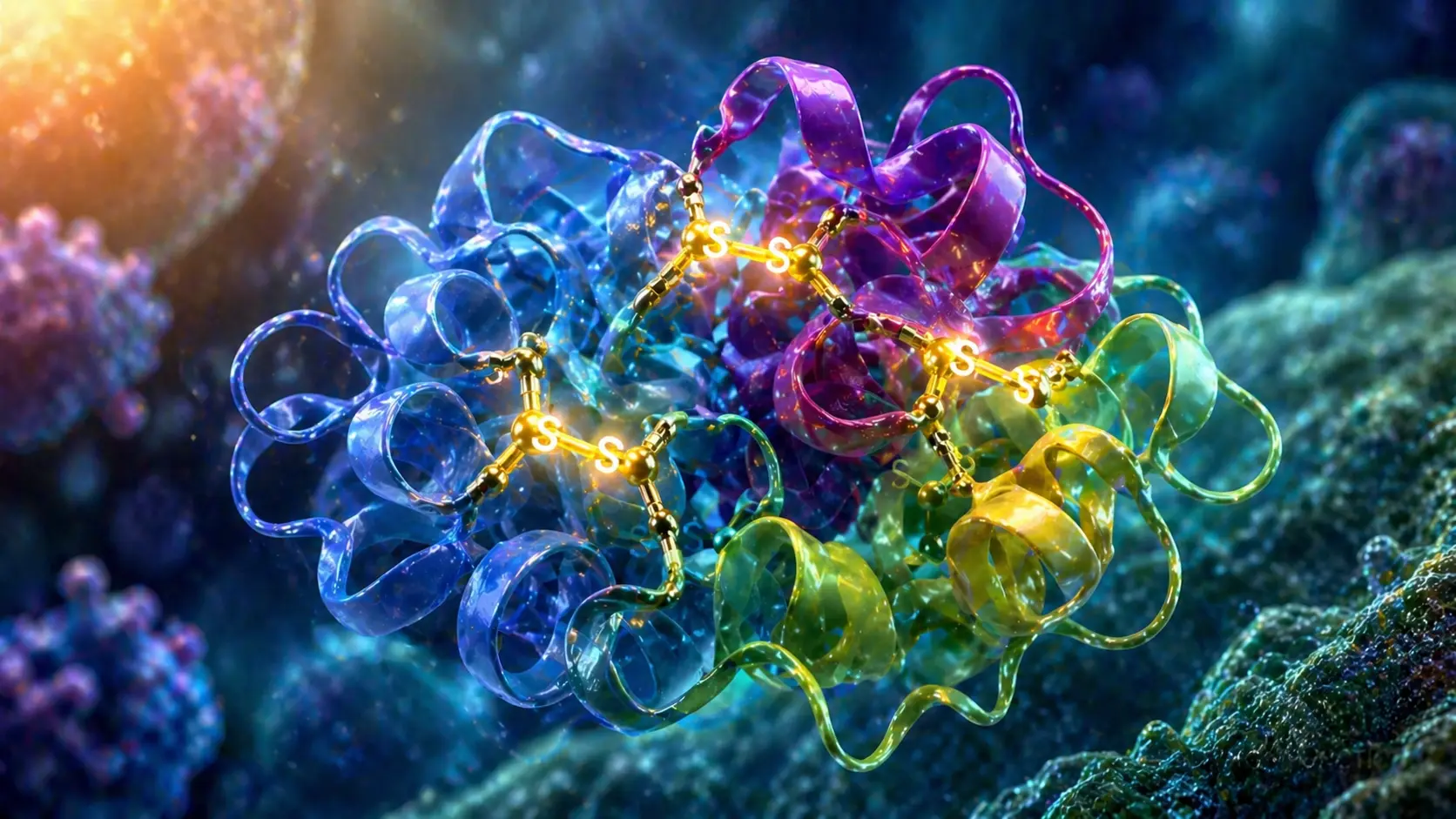
In biological systems, disulfide bonds contribute significantly to the tertiary and quaternary structures of proteins. They are often found in extracellular proteins, where they help resist degradation and maintain function under oxidative conditions (see infographic image 1).
The Role of Disulfide Bonds in Protein Structure
Disulfide bonds are more than just chemical links; they act as molecular staples that hold protein shapes together. Here’s how:
- Stabilization of Structure: By bridging different parts of a protein, disulfide bonds help maintain specific 3D conformations.
- Resistance to Denaturation: Proteins with disulfide bonds are often more resilient to heat, pH changes, and proteolytic enzymes.
- Support for Functionality: Proper folding facilitated by disulfide bridges ensures that active sites and binding regions form correctly.
Benefits of Using Disulfide Bonds in Protein Engineering
By unlocking the potential of disulfide bonds in protein design, we can enhance stability, improve therapeutic applications, and build more robust proteins for a variety of industrial and medical needs.
1. Enhanced Protein Stability: One of the most sought-after goals in protein engineering is stability. Disulfide bonds provide a straightforward way to achieve it. T4 lysozyme has been engineered for enhanced thermal stability by incorporating a disulfide bond, enabling it to retain its enzymatic activity at elevated temperatures. See detail in “T4 Lysozyme: A Protein Engineering Marvel to Boost Enzyme Stability“
2. Improved Therapeutic Potential: Biopharmaceuticals like insulin and monoclonal antibodies depend on disulfide bonds for their activity. Proper bond formation ensures consistent performance.
3. Resistance to Environmental Stress: Proteins used in harsh industrial or environmental settings benefit from the extra robustness provided by disulfide bridges.
4. Rational Design of Enzymes: Protein engineers can introduce disulfide bonds at strategic locations to enhance enzyme efficiency and longevity.
| Table 1: Key Roles and Benefits of Disulfide Bond in Protein Engineering | ||
| Function | Description | Example |
| Structural Stabilization | Disulfide bonds act as molecular staples, preserving the 3D conformation. | Ribonuclease A — retains activity after refolding due to S–S bonds. |
| Thermal & pH Resistance | Proteins with S–S bonds resist harsh conditions like heat and acidity. | Thermophilic enzymes — engineered with extra S–S bonds for industry use. |
| Improved Drug Performance | Ensures therapeutic proteins maintain proper folding and function. | Insulin — contains inter- and intra-chain disulfide bonds. |
| Industrial Robustness | Enhances durability of enzymes in detergents, food processing, and textiles. | Subtilisin — modified with disulfide bridges for laundry detergents. |
| Targeted Folding Support | Facilitates proper folding critical for enzymatic activity. | Tissue Plasminogen Activator (tPA) — folding enhanced by engineered S–S bonds. |
| Longevity in Host Systems | Provides resistance to degradation and prolongs activity. | Erythropoietin (EPO) — disulfide-stabilized form for therapeutic use. |
How to Implement Disulfide Bond Step by Step
Steps
- Identify Target Cysteines – Use bioinformatics tools to find possible sites for cysteine introduction.
- Mutagenesis – Introduce mutations that replace amino acids with cysteine residues.
- Modeling & Simulation – Use software to predict if the disulfide bond will stabilize the protein structure.
- Expression – Express the modified protein in suitable systems (e.g., E. coli, yeast).
- Folding Assistance – Add oxidizing agents or foldases to aid disulfide bond formation.
- Testing – Confirm bond formation and test functionality through assays.
Real-World Examples of Disulfide Bond Applications
Disulfide bonds play a vital role in enhancing protein performance across various fields—here are some real-world examples showcasing their impactful applications (Table 2).
Biopharmaceuticals
- Insulin: Contains essential disulfide bridges that maintain its functional conformation.
- Monoclonal Antibodies: Their Y-shaped structure is stabilized by multiple disulfide bonds.
Industrial Enzymes
- Enzymes used in detergents, textile, and food industries often have engineered disulfide bonds for extra durability.
Synthetic Biology
- Researchers create novel proteins with custom disulfide patterns to mimic or enhance natural functions.
| Table 2: Real-World Applications of Disulfide Bond Engineering (with Examples) | ||
| Application Area | Example | Role of Disulfide Bonds |
| Biopharmaceuticals | Insulin, Erythropoietin (EPO) | Stabilize folding and ensure therapeutic functionality. |
| Antibody Design | Trastuzumab (Herceptin), Rituximab | Maintain structural integrity and binding capability through inter-chain S–S bonds. |
| Industrial Enzymes | Protease in Tide Detergent | Disulfide bridges confer resistance to oxidation and heat. |
| Synthetic Biology | Self-healing hydrogels with Cys-modified proteins | Utilize reversible S–S bonds to allow autonomous repair of material. |
| Vaccines | Recombinant Hepatitis B surface antigen | Stabilized by disulfide bonds to maintain immunogenic structure. |
| Controlled Drug Release | Redox-sensitive nanoparticles | Drugs are released in tumor microenvironments by breaking S–S bonds in response to reducing agents like glutathione. |
Common Mistakes to Avoid with Disulfide Bond
- Overuse of Disulfide Bonds: More isn’t always better. Excessive disulfide bonding can make proteins overly rigid or prone to misfolding.
- Incorrect Cysteine Pairing: Disulfide bonds need correct spatial orientation. Wrong placements lead to ineffective or inactive proteins.
- Neglecting Redox Environment: Disulfide bond formation requires an oxidizing environment. Ignoring this can result in incomplete bond formation.
- Ignoring Folding Pathways: Bond formation should complement, not hinder, the protein’s natural folding pathway.
Best Practices for Disulfide Bond Engineering
When engineering disulfide bonds into proteins, several best practices enhance success.
- Limiting bonds to 1–2 per domain preserves flexibility and avoids disrupting natural protein function.
- Computational modeling tools should be employed to predict stabilizing effects and optimize bond placement before lab experimentation. F
- inally, spectroscopic validation (e.g., circular dichroism or X-ray crystallography) is critical to confirm structural integrity after modification.
Together, these steps balance stability, functionality, and innovation in protein design.
Future of Disulfide Bond Applications in Protein Engineering
As our understanding of protein structures deepens, the precision of disulfide bond engineering is bound to improve. AI and machine learning tools now aid in predicting the best cysteine pairings. Moreover, advances in CRISPR and gene-editing allow more accurate in vivo applications, making disulfide bond manipulation a key tool in therapeutic design.
Conclusion
Disulfide bond engineering has become a cornerstone in modern protein design. Its applications span from medicine to industry, offering enhanced stability, improved functionality, and broader adaptability. Whether you’re a student learning biochemistry or a content creator simplifying complex science, the value of understanding disulfide bonds is immense.
By leveraging the power of disulfide bond in protein engineering, we pave the way for next-gen biologics and industrial enzymes. Dive deeper, experiment responsibly, and share your insights—because even the smallest bond can create monumental impacts.
Frequently Asked Questions & Answers
What is a disulfide bond and why is it important in protein engineering?
A disulfide bond is a covalent link formed between two cysteine residues via their sulfur atoms (S–S bond). In protein engineering, it plays a vital role in maintaining the protein’s 3D structure, enhancing thermal stability, and ensuring proper folding—making proteins more robust for therapeutic, industrial, and synthetic biology applications.
How do disulfide bonds improve protein stability?
Disulfide bonds act as molecular staples that lock protein structures into stable conformations. This prevents denaturation under extreme conditions like heat or acidic pH, which is especially valuable in enzyme design, drug development, and manufacturing of biologics such as insulin and antibodies.
How are disulfide bonds introduced into proteins during engineering?
Engineers introduce disulfide bonds by identifying strategic cysteine sites through bioinformatics, modifying genes via mutagenesis, modeling potential structural impacts, expressing the protein in oxidizing environments, and validating bond formation with biochemical assays—ensuring structural accuracy and functional gain.
What are real-world examples of disulfide bond applications?
Disulfide bonds are used in various fields: such as;
Synthetic Biology: Redox-sensitive hydrogels use reversible S–S bonds for self-repair mechanisms. Biopharmaceuticals: Insulin and erythropoietin use them for functional folding. Industrial Enzymes: Proteases in detergents are engineered for heat and oxidation resistance.
What are common mistakes to avoid when engineering disulfide bonds?
Key pitfalls include overusing disulfide bonds, incorrect cysteine placements, ignoring the protein’s folding pathway, and neglecting the redox environment needed for bond formation. These mistakes can lead to protein misfolding or reduced activity, undermining engineering goals.