
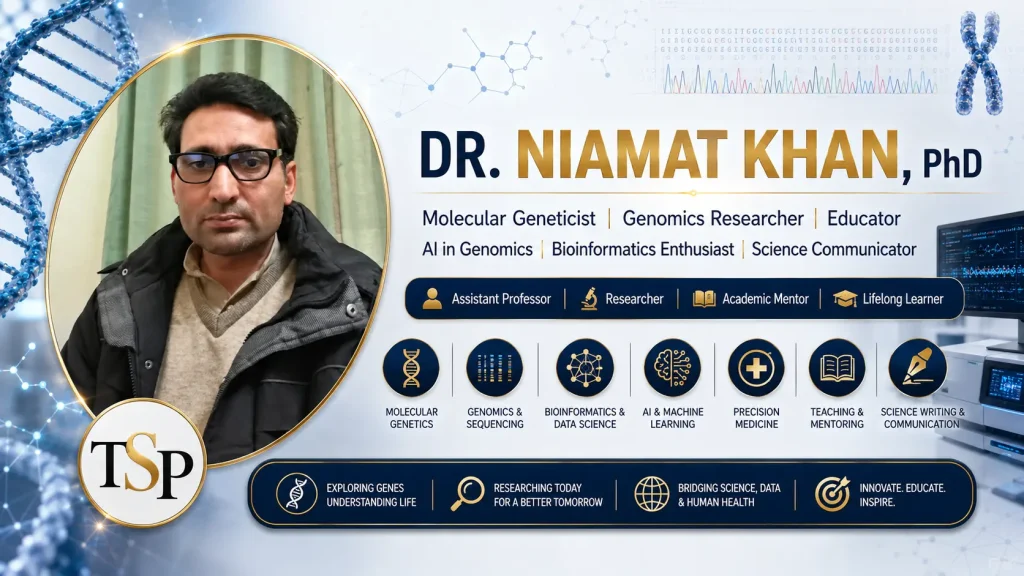
About Dr. Niamat Khan
Molecular Geneticist | Genomics Researcher | Educator | AI in Genomics
Dr. Niamat Khan is a molecular geneticist, genomics researcher, and university educator with more than 19 years of experience in genetics and molecular biology research and teaching.
He currently serves as an Assistant Professor in the Department of Biotechnology & Genetic Engineering at Kohat University of Science & Technology (KUST), Pakistan, where he teaches genetics, molecular biology, genomics, and related biomedical sciences.
His research career spans molecular genetics, human genetic disorders, neurogenetics, cancer genetics, genomic medicine, molecular biology, and bioinformatics. His international research experience includes work at the University Hospital Frankfurt and the University Medical Center Göttingen in Germany, as well as research collaborations with institutions in the United Kingdom and Italy.
19+ Years of Teaching & Research Experience in Genetics, Molecular Biology & Genomics
Dr. Khan has also completed specialized training and courses in Artificial Intelligence (AI) and its applications in genomics and biomedical research. He is actively exploring how AI-driven approaches can be applied to genetics research to gain precisely accurate information, enhance genomic data interpretation, accelerate variant prioritization, and improve diagnostic accuracy in inherited disorders.
His research interests include understanding the molecular and genetic basis of inherited human disorders, particularly neurological and developmental disorders identified in Pakistani families. He is also interested in cancer genetics, molecular mechanisms of disease, genetic diagnosis, variant interpretation, next-generation sequencing, and the application of emerging technologies—including artificial intelligence and machine learning—to genomic medicine.
Through The Scholar Post, Dr. Khan aims to make complex developments in genetics, genomics, molecular biology, biotechnology, and genomic medicine understandable, scientifically accurate, and useful for students, educators, researchers, and healthcare professionals.
TSP | The Scholar Post
Making Genetics, Genomics & Molecular Science Understandable.
Academic Credentials
| Qualification | Institution | Field |
|---|---|---|
| Ph.D. | University Medical Center Göttingen, Germany | Biology / Molecular Genetics |
| M.Phil. (Genetics) | Quaid-i-Azam University, Islamabad | Genetic Diversity & Molecular Markers |
| M.Sc. (Genetics) | University of Karachi | Genetics |
Ph.D. Research
Comparative DNA-Protein Interaction and Epithelial Tight Junctions Modulation Potential of Immunosuppressive Regime
Funding: HEC/DAAD Pakistan-Germany Research Program
AI & Computational Genomics Training
Dr. Khan has completed specialized training and courses in Artificial Intelligence, Machine Learning, and Computational Genomics, focusing on their application to genetics and biomedical research.
Key Training Areas
- AI in Genomics & Precision Medicine
- Machine Learning for Genomic Data Analysis
- AI-Assisted Variant Interpretation & Prioritization
- Deep Learning in Biomedical Research
- Computational Genomics & Bioinformatics
- AI for Rare Disease Diagnosis
- Genomic Data Science & Statistical Learning
- AI in Cancer Genomics & Precision Oncology
Applying AI to Genetics Research
Dr. Khan is actively exploring how Artificial Intelligence (AI) can be applied to genetics and genomics research to achieve precisely accurate information in the following areas:
| Application | Description |
|---|---|
| AI-Assisted Variant Interpretation | Using machine learning algorithms to predict pathogenicity of genetic variants with higher accuracy. |
| Genomic Data Analysis | Applying AI to analyze large-scale genomic datasets (WES, WGS) for faster and more accurate variant calling. |
| Phenotype-to-Gene Prioritization | Leveraging AI to match clinical phenotypes with candidate genes for rare disease diagnosis. |
| AI in Cancer Genomics | Using deep learning to identify oncogenic mutations and predict treatment responses. |
| Precision Medicine | Integrating AI with genomic data for personalized treatment recommendations. |
| Drug Discovery & Pharmacogenomics | Applying AI to predict drug responses based on genetic profiles. |
| Automated Literature Mining | Using AI to extract relevant genetic information from millions of research papers. |
His goal is to integrate AI-driven approaches with traditional molecular genetics research to enhance the accuracy, speed, and precision of genetic diagnosis, particularly for rare and inherited disorders in underrepresented populations.
Research Expertise
Dr. Khan’s research and academic interests span several interconnected areas of modern genetics and biomedical science.
Human & Clinical Genetics
- Human genetic disorders
- Genetic diagnosis
- Genetic variant interpretation
- Inherited diseases
- Genomic medicine
- Precision medicine
Neurogenetics
- Hereditary spastic paraplegia
- Cerebellar ataxia
- Epilepsy genetics
- Hereditary motor sensory neuropathies
- Neurodevelopmental disorders
Cancer Genetics & Molecular Cancer Biology
- Cancer genetics
- Leukemia biology
- Receptor tyrosine kinase pathways
- Molecular mechanisms of cancer
- Oncogenetics
Molecular Biology
- DNA-protein interactions
- Chromatin biology
- Protein-protein interactions
- Molecular markers
- Gene regulation
- Molecular mechanisms of disease
Microbial Genetics
- Bacterial genomics
- Antimicrobial resistance
- Molecular characterization
- Microbial genetic analysis
Genomics & Bioinformatics
- Whole-exome sequencing (WES)
- Whole-genome sequencing (WGS)
- Next-generation sequencing
- Variant analysis
- Genomic data interpretation
- Protein modeling
- In-silico analysis
AI in Genomics & Precision Medicine
- AI-assisted variant interpretation
- Machine learning in genomics
- Deep learning for genomic data
- AI in rare disease diagnosis
- Precision medicine
- AI-driven drug discovery
International Research Experience
University Hospital Frankfurt, Germany
Laboratory for Molecular Hematology and Oncology
*2011–2012*
Research focus:
The degradation of receptor tyrosine kinases in leukemia
This work focused on molecular mechanisms involved in receptor tyrosine kinase degradation and their relevance to leukemia biology.
University Medical Center Göttingen, Germany
Department of Clinical Chemistry
*2013–2016*
Research focus:
Comparative DNA-Protein Interaction and Epithelial Tight Junctions Modulation Potential of Immunosuppressive Regime
This research investigated DNA-protein interactions, chromatin-associated proteins, epithelial tight-junction biology, and the molecular effects of immunosuppressive treatment.
Current Research Interests
Dr. Khan’s current research interests focus particularly on the genetic basis of inherited human disorders and the application of molecular and genomic technologies to understand disease mechanisms.
Major areas include:
- Hereditary neurological disorders
- Hereditary spastic paraplegia
- Cerebellar ataxia
- Epilepsy and associated genetic disorders
- Hereditary motor sensory neuropathies
- Retinal dystrophies
- Intellectual disability
- Genetic variation in Pakistani families
- Cancer genetics
- Genomic medicine
- Genetic diagnosis and variant interpretation
- AI-assisted genomic data analysis
- Machine learning for variant prioritization
- Precision medicine
A particular focus of his research has been the investigation of genetic disorders in Pakistani families, contributing to a better understanding of genetic diversity and disease-associated variants in an underrepresented population.
International Research Collaborations
Dr. Khan has participated in research collaborations involving institutions in Europe and Asia.
| Institution | Country | Research Area |
|---|---|---|
| University Hospital Frankfurt | Germany | Receptor tyrosine kinase degradation in leukemia |
| University Medical Center Göttingen | Germany | Tight-junction biology and molecular mechanisms |
| University of Exeter | United Kingdom | Hereditary spastic paraplegia, ataxia & motor sensory neuropathies |
| University of Bologna | Italy | Epilepsy genetics and comorbidities |
These collaborations have contributed to research investigating inherited neurological, developmental, ophthalmological, and other genetic disorders in Pakistani families.
Selected Research Publications
Dr. Khan has contributed to peer-reviewed research in human genetics, neurogenetics, cancer biology, molecular biology, and genomic medicine.
2025
- Dawood, M., Ji, X., Shah, I. U., Khan, N. , Xue, S., & Saleha, S. (2025). Genotypic and phenotypic spectrum of anophthalmia/microphthalmia in families from Khyber Pakhtunkhwa, Pakistan. Journal of Human Genetics, *70*, 565–575. https://doi.org/10.1038/s10038-025-01382-6
- Saeed, M. N., Rehman, M., Nughman, M., Khan, N. , Ahmed, F., Ullah, S., Shojonov, M., Madaminov, B., Naeem, R., & Kinki, A. B. (2025). Association of HLA-B gene polymorphism and blood groups with COVID-19 susceptibility and severity. Scientific Reports, *15*, 31775. https://doi.org/10.1038/s41598-025-15455-1
2024
- Ahmed, A. N., Rawlins, L. E., Khan, N. , Jan, Z., Ubeyratna, N., Voutsina, N., Azeem, A., Khan, S., Baple, E. L., Crosby, A. H., & Saleha, S. (2024). Expanding the genetic spectrum of hereditary motor sensory neuropathies in Pakistan. BMC Neurology, *24*(1), 394. https://doi.org/10.1186/s12883-024-03882-y
- Azeem, A., Ahmed, A. N., Khan, N. , Voutsina, N., Ullah, I., Ubeyratna, N., Yasin, M., Baple, E. L., Crosby, A. H., Rawlins, L. E., & Saleha, S. (2024). Investigating the genetic basis of hereditary spastic paraplegia and cerebellar ataxia in Pakistani families. BMC Neurology, *24*, 354. https://doi.org/10.1186/s12883-024-03855-1
- Yasin, N., Rahman, H., Qasim, M., Nisa, I., Sarwar, Y., Khan, N. , Alzahrani, K. J., Alsuwat, M. A., Alzahrani, F. M., & Aljohani, A. (2024). Metabolic proteins expression up-regulated in blood-borne extensively drug-resistant Salmonella Typhi isolates from Pakistan. Medicina, *60*(9), 1404. https://doi.org/10.3390/medicina60091404
- Yasin, M., Licchetta, L., Khan, N. , Ullah, I., Jan, Z., Dawood, M., Ahmed, A. N., Azeem, A., Minardi, R., Carelli, V., & Saleha, S. (2024). Genetic heterogeneity in epilepsy and comorbidities: Insights from Pakistani families. BMC Neurology, *24*(1), 172. https://doi.org/10.1186/s12883-024-03671-7
2023
- Hussain, H., Naeem, R., Khattak, B., Rehman, Z. U., Khan, N. , Qureshi, M. K., Deeba, F., Ali, I., & Khan, M. D. (2023). Physiological and metabolic changes in maize seedlings in response to bisphenol A stress. Journal of Soil Science and Plant Nutrition, *23*(4), 6551–6572. https://doi.org/10.1007/s42729-023-01510-1
- Hussain, S. I., Muhammad, N., Shah, S. U. D., Fardous, F., Khan, S. A., Khan, N. , Rehman, A. U., Siddique, M., Wasan, S. A., Niaz, R., Ullah, H., Khan, N. , Muhammad, N., Mirza, M. U., Wasif, N., & Khan, S. (2023). Structural and functional implications of SLC13A3 and SLC9A6 mutations: An in silico approach to understanding intellectual disability. BMC Neurology, *23*, 353. https://doi.org/10.1186/s12883-023-03397-y
- Awais, S., Shah, S. A., Khan, N. , Khan, N., Jamila, N., Nishan, U., Jan, M. I., Hwang, I. M., & Ali, E. A. (2023). Hydroxyquinoline sulfanilamide ameliorates STZ-induced hyperglycemia-mediated amyloid beta burden and memory impairment in adult mice. Open Chemistry, *21*(1), 20220346. https://doi.org/10.1515/chem-2022-0346
- Marwan, M., Dawood, M., Ullah, M., Shah, I. U., Khan, N. , Hassan, M. T., Karam, M., Rawlins, L. E., Baple, E. L., Crosby, A. H., & Saleha, S. (2023). Unravelling the genetic basis of retinal dystrophies in Pakistani consanguineous families. BMC Ophthalmology, *23*, 205. https://doi.org/10.1186/s12886-023-02948-8
- Shahid, R., Yasin, M., Rehman, Z. U., Jadoon, H., Tahir, H., Meraj, N., Khan, N. , Zubair, M., Zulfiqar, I., Nowshid, M., Azeem, A., Jabeen, M., Hameed, A., & Saleha, S. (2023). Maternal FMR1 alleles expansion in newborns during transmission: A prospective cohort study. Pediatric Research. https://doi.org/10.1038/s41390-022-02128-2
2022
- Yasin, N., Rahman, H., Sarwar, Y., Qasim, M., Nisa, I., Ikram, A., Zaman, G., Khan, Z., Mirza, M. R., Khan, N. , Safi, A. U. R., & Alzahrani, K. J. (2022). Salmonella Typhi from Northwest Pakistan: Molecular strain typing and drug resistance signature. Microbial Drug Resistance, *28*(1), 120–126. https://doi.org/10.1089/mdr.2020.0304
Ullah, F., Zaman, S., Ullah, W., Ali, S., Qasim, M., Muhammad, N., Mehmood, M., Ali, N., & Khan, N.(2022). Elucidation of antibacterial activity of Bacillus sp. and Alcaligenes sp. metabolites against multidrug-resistant bacteria. Nova Biotechnologica et Chimica, *21*(2), e1337. https://doi.org/10.36547/nbc.1337
Meraj, N., Yasin, M., Rehman, Z. U., Tahir, H., Jadoon, H., Khan, N. , Shahid, R., Zubair, M., Zulfiqar, I., Jabeen, M., Neelam, S., Hameed, A., & Saleha, S. (2022). Fragile X premutation carrier screening in Pakistani preconception women in primary care consultation. BMC Women’s Health, *22*, 57. https://doi.org/10.1186/s12905-022-01632-1
2021
- Khan, N. , Shahid, S., & Asif, A. R. (2021). Current analytical strategies in studying chromatin-associated-proteome (chromatome). Molecules, *26*(21), 6694. https://doi.org/10.3390/molecules26216694
- Dawood, M., Lin, S., Din, T. U., Shah, I. U., Khan, N. , Jan, A., Marwan, M., Sultan, K., Nowshid, M., Tahir, R., Ahmed, A. N., Yasin, M., Baple, E. L., Crosby, A. H., & Saleha, S. (2021). Novel mutations in PDE6A and CDHR1 cause retinitis pigmentosa in Pakistani families. International Journal of Ophthalmology, *14*(12), 1843–1851. https://doi.org/10.18240/ijo.2021.12.06
- Ahmed, A. N., Tahir, R., Khan, N. , et al. (2021). USH2A gene variants cause keratoconus and Usher syndrome phenotypes in Pakistani families. BMC Ophthalmology, *21*, 191. https://doi.org/10.1186/s12886-021-01957-9
2020
- Ullah, Z., Ali, S., Muhammad, N., Khan, N. , Rizwan, M., Khan, M. D., Khan, N. , Khattak, B., Alhaithloul, H. A. S., Soliman, M. H., Ullah, H., Begum, D., Ali, N., & Hashmatullah. (2020). Biochar impact on microbial population and elemental composition of red soil. Arabian Journal of Geosciences, *13*, 757. https://doi.org/10.1007/s12517-020-05671-6
- Khan, S. A., Khan, M. A., Muhammad, N., Bashir, H., Khan, N. , Muhammad, N., Yilmaz, R., Khan, S., & Wasif, N. (2020). A novel nonsense variant in SLC24A4 causing a rare form of amelogenesis imperfecta in a Pakistani family. BMC Medical Genetics, *21*, 97. https://doi.org/10.1186/s12881-020-01038-6
2017
- Khan, N. , Binder, L., Pantakani, D. V. K., & Asif, A. R. (2017). MPA modulates tight junctions’ permeability via midkine/PI3K pathway in Caco-2 cells: A possible mechanism of leak-flux diarrhea in organ transplanted patients. Frontiers in Physiology, *8*, 438. https://doi.org/10.3389/fphys.2017.00438
2016
- Khan, N. , Lenz, C., Binder, L., Pantakani, D. V. K., & Asif, A. R. (2016). Active and repressive chromatin-associated proteins profiling after MPA treatment and the role of midkine in epithelial monolayer permeability. International Journal of Molecular Sciences, *17*(4), 597. https://doi.org/10.3390/ijms17040597
2015
- Khan, N. , & Asif, A. R. (2015). Transcriptional regulators of claudins in epithelial tight junctions. Mediators of Inflammation, *2015*, Article 219843. https://doi.org/10.1155/2015/219843
2014
- Khan, N. , & Asif, A. R. (2014). Tight junction integrity: Need for non-invasive markers. Journal of Clinical & Cellular Immunology, *5*(1), e115. https://doi.org/10.4172/2155-9899.1000e115
2012
- Mufti, F. U., Ullah, H., Bangash, A., Khan, N. , Hussain, S., Ullah, F., Jamil, M., & Jabeen, M. (2012). Antimicrobial activities of Aerva javanica and Paeonia emodi plants. Pakistan Journal of Pharmaceutical Sciences, *25*(3), 565–569
Research Projects
Dr. Khan has contributed to research projects investigating the molecular and genetic basis of inherited human disorders.
Major Research Areas
Hereditary Spastic Paraplegia & Cerebellar Ataxia
Investigation of genetic causes of inherited movement disorders in Pakistani families.
Hereditary Motor Sensory Neuropathies
Research into the genetic spectrum of inherited peripheral neuropathies.
Epilepsy Genetics
Investigation of genetic heterogeneity and clinical comorbidities associated with epilepsy.
Retinal Dystrophies
Molecular investigation of inherited retinal disorders in Pakistani families.
Fragile X Premutation Screening
Research involving FMR1 premutation carrier screening in preconception populations.
AI-Integrated Research Initiatives (Emerging)
AI-Assisted Variant Prioritization in Rare Diseases
Developing machine learning approaches to prioritize disease-causing variants in WES/WGS data from Pakistani families.
AI for Phenotype-Genotype Correlation
Exploring AI models to improve matching of clinical phenotypes with genetic variants.
Deep Learning in Genomic Medicine
Investigating the application of deep learning to improve diagnostic accuracy in inherited disorders.
Teaching, Mentoring & Academic Contributions
As an Assistant Professor at KUST, Dr. Khan has taught and contributed to curriculum development in:
- Molecular Genetics
- Human Genetics
- Genomic Medicine
- Neurogenetics
- Cancer Genetics
- Microbial Genetics
- Molecular Biology
- Molecular Cancer Biology
- Next-Generation Sequencing
- Genomic Data Analysis
- Molecular Biology Laboratory Methods
- AI in Genomics & Precision Medicine (Emerging)
He has also supervised and mentored M.Phil. and Ph.D. students and guided undergraduate and graduate research projects in genetics, molecular biology, biotechnology, and genomics.
Conferences, Workshops & Scientific Events
Dr. Khan has also contributed to the organization of scientific conferences and hands-on training activities.
Selected Events
Bio-Hub: International Conference on Future of Biotechnology & Bioengineering — 2025
Role: Organizer
Hands-on NGS: WES Data Analysis Workshop — 2024
Role: Organizer
International Conference on Beyond Traditional Agriculture — 2024
Role: Organizer
International Conference on Emerging Innovative Research Trends in Biology — 2021
Role: Organizer
Why Dr. Niamat Khan Writes for The Scholar Post
Modern genetics is transforming how we understand human disease, inheritance, cancer, and healthcare. The integration of Artificial Intelligence with genomics is accelerating this transformation even further.
Yet advances in genetics, genomic medicine, and AI-driven genomics can be difficult to understand without a strong scientific background.
The Scholar Post was created to help bridge that gap.
As a researcher and educator working across genetics, molecular biology, genomics, biotechnology, and AI in genomics, Dr. Khan translates complex scientific concepts into clear, evidence-based, and accessible educational content.
His goal is to help readers understand not only what scientists have discovered, but also:
- How genetic mechanisms work
- Why genetic variants matter
- How genomic technologies are changing medicine
- What emerging research means for healthcare
- How AI is transforming genetics and genomic medicine
- How students can understand complex biological concepts
- How researchers can follow developments in modern genetics
- What the limitations and challenges of genomic medicine are
The Scholar Post particularly aims to serve students, teachers, researchers, healthcare professionals, biotechnology professionals, and scientifically curious readers.
From the Laboratory to the Classroom — and Beyond
Dr. Khan’s academic journey reflects a continuing connection between research, education, and scientific communication.
His experience spans:
Molecular Research → Human Genetics → Genomics → Disease Mechanisms → AI in Genomics → Education → Scientific Communication
This perspective informs the content published on The Scholar Post, particularly articles covering:
Genetics • Genomics • Molecular Biology • Biotechnology • Genetic Engineering • Cancer Genetics • Neurogenetics • Genomic Medicine • Bioinformatics • Precision Medicine • AI in Healthcare • AI in Genomics
Research & Professional Profiles
For research publications, citations, and academic work, visit Dr. Khan’s professional research profiles:
| Platform | Link |
|---|---|
| Scopus | View Profile |
| Google Scholar | View Profile |
| Web of Science | View Profile |
Scientific & Editorial Interests
Dr. Khan’s ongoing scientific and educational interests include:
Human Genetics | Clinical Genetics | Neurogenetics | Cancer Genetics | Molecular Cancer Biology | Genomic Medicine | Genetic Engineering | Bioinformatics | Next-Generation Sequencing | Genetic Disorders | Precision Medicine | AI in Genomic Medicine | Machine Learning in Genomics | AI-Assisted Diagnosis | Computational Genomics | Protein Engineering
Author & Scientific Content Policy
Articles authored by Dr. Niamat Khan on The Scholar Post are intended to provide educational and scientifically informed information about genetics, genomics, molecular biology, biotechnology, and related biomedical sciences.
Scientific claims are presented with an emphasis on peer-reviewed research, authoritative scientific sources, and evidence-based interpretation.
Where appropriate, articles distinguish established scientific knowledge from emerging findings, ongoing research, hypotheses, and areas of scientific uncertainty.
Medical Disclaimer
Content published on The Scholar Post is intended for educational and informational purposes only. It does not constitute medical advice, diagnosis, or treatment.
Readers should consult an appropriately qualified healthcare professional for individual medical concerns, diagnosis, genetic testing decisions, or treatment recommendations.