
Autism Genetics Decoded: Four Distinct Subtypes Unveiled by Landmark Study
Introduction
Autism Spectrum Disorder (ASD) is one of the most complex neurodevelopmental conditions known today. It affects how people communicate, learn, and experience the world. For decades, researchers have struggled to explain why autism presents so differently from person to person.
A 2025 Nature Genetics study has now taken a huge step forward. By combining advanced machine learning with large-scale genomic analysis, scientists identified four biologically distinct autism subtypes. Each subtype has unique genetic pathways, symptom patterns, and developmental timelines. This discovery is more than an academic breakthrough. It could revolutionize autism diagnosis and treatment, moving away from one-size-fits-all approaches toward precision medicine.
Understanding Autism Spectrum Disorder
What is Autism?
Autism Spectrum Disorder is a neurodevelopmental condition that begins in early childhood. It is characterized by:
- Difficulties in social communication
- Repetitive or restricted behaviors
- Differences in sensory processing
The word “spectrum” reflects its wide variation in abilities and challenges. For example:
- One child may have strong verbal skills but struggle with social cues.
- Another may have minimal speech and need lifelong support.
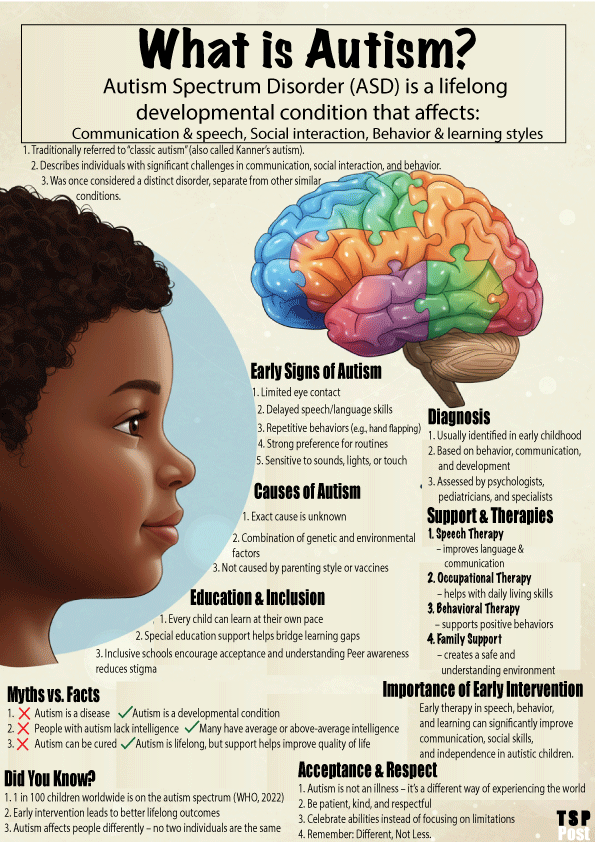
for some basic information see infographic image
Why Genetics Matters in Autism
ASD is influenced by both genetic and environmental factors, but genetics plays a central role. Scientists have identified hundreds of genes linked to autism, yet no single gene causes it in most cases.
Instead, multiple genetic variations—both common and rare—combine to increase autism risk. Some changes are inherited, while others appear spontaneously (de novo mutations). Understanding these genetic factors is critical for:
- Early diagnosis
- Targeted interventions
- Predicting long-term outcomes
Phenotypic Heterogeneity — The Core Challenge
One of the biggest hurdles in autism research is phenotypic heterogeneity—the huge variety in how symptoms appear.
For instance:
- Some autistic people have intellectual disability; others have above-average IQ.
- Some have epilepsy, while others have no medical complications.
- Language skills range from nonverbal to highly articulate.
This diversity makes it hard to link specific genes to specific traits. Past studies often mixed very different cases together, obscuring clear genetic patterns.
The New Study: Breaking Autism into Biological Subtypes
Who Led the Study?
The research was led by Princeton University and the Flatiron Institute, with data from the SPARK autism cohort—the largest autism genetic study in the U.S (detail in Ref. (Litman et al., 2025).
How the Study Was Conducted
Researchers used a method called General Finite Mixture Modeling (GFMM), a machine learning approach that groups people based on patterns in complex data.
The process included:
- Collecting Phenotypic Data — Detailed information on 239 traits such as language milestones, motor skills, co-occurring conditions, and age at diagnosis.
- Identifying Clusters — Using GFMM to group individuals with similar traits.
- Analyzing Genomes — Examining common genetic variants, rare inherited mutations, and de novo mutations.
- Linking to Brain Development — Mapping genes to specific cell types and developmental stages.
Why This Approach Works
By grouping people first based on clinical features, researchers avoided mixing unrelated cases. This made the genetic signals much clearer. They could then match genetic changes to specific biological pathways and developmental time windows.
The Four Autism Subtypes
Social/Behavioral (37% of participants)
Key Traits:
- Significant social communication difficulties
- High repetitive behaviors
- Frequent ADHD, anxiety, and depression
- Few early developmental delays
Genetic Findings:
- Highest polygenic risk scores for ADHD and depression
- De novo mutations in genes active after birth in inhibitory brain neurons
- Disruption of chromatin regulation and DNA repair pathways
Clinical Implications:
This subtype is often diagnosed later, since early milestones may seem typical. These individuals may respond well to behavioral therapy combined with ADHD or anxiety treatments.
Mixed ASD with Developmental Delay (19%)
Key Traits:
- Speech and language delays
- Motor coordination problems
- Intellectual disability
- Milder behavioral challenges
Genetic Findings:
- Strong inherited rare mutations from parents
- De novo mutations in prenatal neuronal genes
- Disruptions in voltage-gated sodium channels and neuronal firing mechanisms
Clinical Implications:
This group is typically diagnosed earliest, often in infancy. Early, intensive therapies—speech, occupational, and physical—are crucial.
Broadly Affected (10%)
Key Traits:
- Impairments across cognitive, motor, and behavioral domains
- High medical complexity (seizures, congenital anomalies)
Genetic Findings:
- Heaviest load of de novo mutations
- Many mutations in FMRP target genes, linked to Fragile X syndrome
- Disruption across all major brain cell types and developmental periods
Clinical Implications:
This group often requires multidisciplinary care—neurology, psychiatry, and therapy teams. High recurrence risk exists due to spontaneous mutations.
Moderate Challenges (34%)
Key Traits:
- Milder difficulties across domains
- Fewer co-occurring conditions
Genetic Findings:
- Mutations in less constrained genes (more tolerant to variation)
- Enrichment for histone modifiers (epigenetic regulators)
Clinical Implications:
With early behavioral intervention, individuals in this group often have favorable long-term outcomes.
Why This Discovery is a Game Changer
From Spectrum to Multiple Spectra
Historically, autism was seen as a single spectrum from mild to severe. This study shows multiple overlapping spectra, each with its own biology.
Solving the “Missing Heritability” Puzzle
The genetic architecture differs across subtypes:
- Social/Behavioral: Common variants dominate.
- Mixed with Delays: Rare inherited variants dominate.
- Broadly Affected: De novo mutations dominate.
This explains why earlier studies found inconsistent results.
Importance of Developmental Timing
When the genetic disruptions occur matters:
- Prenatal changes → early developmental delays.
- Postnatal changes → later behavioral challenges.
Knowing the timing can guide when to intervene.
Real-World Implications
For Families
- Clearer prognosis based on subtype.
- Personalized therapy plans (e.g., motor therapy for developmental delay subtype, social skills training for social/behavioral subtype).
And For Clinicians
- Potential for genetic testing to identify subtype.
- More accurate treatment matching and progress monitoring.
Similarly For Researchers
- Precise biological targets for new drugs.
- Better-designed clinical trials focused on one subtype at a time.
Limitations and Future Directions
Current Limitations
- Most participants were U.S.-based and of European ancestry.
- Data relied partly on caregiver reports, which may have bias.
- Long-term outcomes for subtypes are not yet fully known.
Next Steps
- Global Studies to validate findings across populations.
- Brain Imaging & Digital Phenotyping to refine subtypes further.
- Subtype-Specific Clinical Trials to test targeted therapies.
A New Hope for Personalized Autism Care
As senior author Olga Troyanskaya states:
“We’re moving beyond the idea of autism as one condition. These subtypes have fundamentally different biologies—which means they may need different treatments.”
This is a turning point. With more research, autism care may shift from general strategies to tailored, biology-based interventions—maximizing each individual’s potential.
Key Takeaways for Students and Professionals
- Autism’s diversity stems partly from distinct genetic programs.
- Phenotypic clustering before genetic analysis reveals clearer patterns.
- Both common and rare genetic variants contribute to ASD risk.
- Timing and brain-region-specific gene activity are critical in symptom development.
Further Readings
- SPARK for Autism Project – https://sparkforautism.org
- CDC – Autism Spectrum Disorder Basics – https://cdc.gov/autism
- Autism Science Foundation – https://autismsciencefoundation.org
- Litman, A., Sauerwald, N., Green Snyder, L. et al. Decomposition of phenotypic heterogeneity in autism reveals underlying genetic programs. Nat Genet 57, 1611–1619 (2025). https://doi.org/10.1038/s41588-025-02224-z
- Geschwind, D. H., & State, M. W. (2015). Gene hunting in autism spectrum disorder: on the path to precision medicine. The Lancet. Neurology, 14(11), 1109–1120. https://doi.org/10.1016/S1474-4422(15)00044-7
Autism FAQs: Scientifically Accurate and Easy-to-Understand Answers
What is autism spectrum disorder (ASD)?
Autism spectrum disorder is a neurodevelopmental condition that influences how the brain processes information. It affects communication, behavior, and social interaction. Because symptoms vary in type and intensity, ASD is described as a spectrum. This understanding helps explain why each autistic person has unique strengths and challenges.
What are early signs of autism in children?
Early indicators may include delayed speech, reduced eye contact, or repetitive actions like hand-flapping. Children might also prefer routines or focus intensely on specific interests. Recognizing these behaviors early allows professionals to confirm autism and begin helpful support strategies sooner.
How does autism affect social interaction?
Many autistic individuals find it difficult to interpret facial expressions, body language, or tone of voice. Therefore, conversations can feel confusing or overwhelming. However, with understanding and tailored support, autistic people can develop rewarding social connections and meaningful relationships.
What causes autism spectrum disorder?
Scientists agree that autism has no single cause. Instead, it arises from a combination of genetic and environmental factors that influence brain development. Because research continues to uncover these links, ongoing studies may provide deeper insights into autism’s biological basis.
Can therapy help autistic children and adults?
Yes, therapies such as behavioral, speech, and occupational interventions improve communication, learning, and daily living skills. Because therapy is personalized, it builds on each person’s abilities and reduces challenges. Also, timely therapy supports long-term independence and quality of life.
Why is early autism diagnosis important?
Early diagnosis gives families access to specialized education and therapeutic services. Therefore, children can learn adaptive skills more effectively during critical developmental stages. Early recognition also lowers family stress and improves long-term developmental outcomes.