
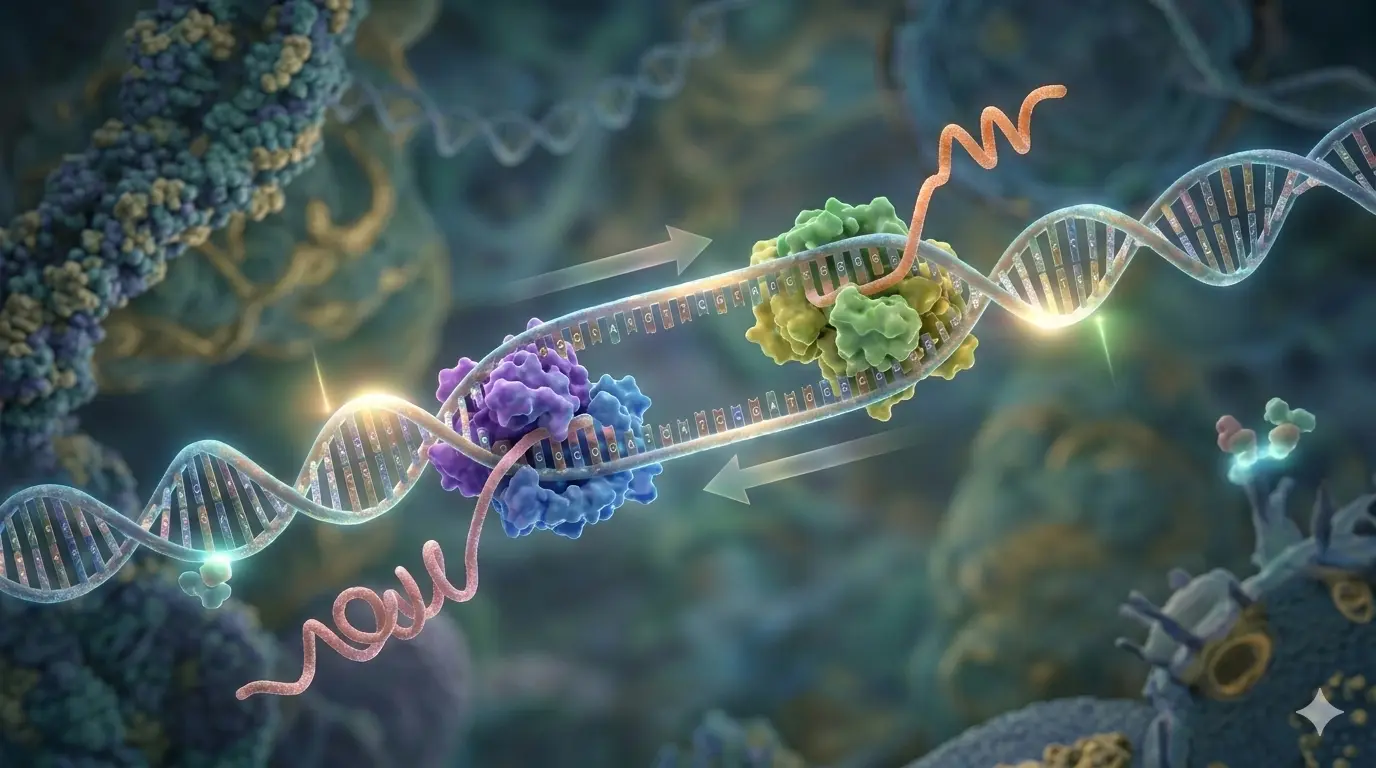
Convergent Promoters: Beyond Interference, Toward Coordination
Traditionally, Genes control all most all cellular activities of an organism. Therefore, gene regulation is a fundamental process that influences development, cellular functions, and disease progression etc. For decades, life scientists traditionally believed convergent promoters—where two adjacent genes transcribe in opposite directions—caused transcriptional interference. Previously, researchers viewed these genomic regions as sites of transcriptional collisions. However, a groundbreaking study by Wiechens et al. (2025), published in Nature Genetics, challenges this long-held assumption. Surprisingly, Wiechens’ findings demonstrates that convergent promoters actively coordinate gene expression rather than simply causing interference. Therefore. the aim of this blog post to explore their findings. Furthermore, to evaluate these findings with the implications for genetics and medicine, and future research directions.
What Are Convergent Promoters?
Before exploring these findings, let’s review convergent promoter basics.
- Convergent promoters are bidirectional transcriptional elements where overlapping genes are transcribed in opposite directions. Or in simple words, “Convergent promoters are genomic regions where two genes are transcribed toward each other (in opposite directions), sharing a regulatory space.”
- Historically, these promoters were thought to disrupt gene expression due to RNA polymerase collisions.
- However, the latest research demonstrates that these promoters instead enhance gene regulation, offering a more complex and dynamic model of transcription.
Key Discoveries from the Study
Scientists once dismissed convergent promoters as genomic oddities, but Wiechens et al. (2025) revealed their central role in gene regulation through four groundbreaking discoveries
- Convergent promoters are widespread: They account for about 25% of all active transcription start sites (TSSs).
- They exhibit positive co-regulation, meaning that transcription from one promoter can boost expression from the adjacent promoter.
- Discovery of downstream antisense RNAs (daRNAs): These newly identified RNAs suggest an extra layer of gene regulation.
- Transcription factors influence both promoters: A transcription factor binding at one promoter can regulate gene expression at the adjacent promoter.
Advanced Genomic Techniques Used in the Study
Wiechens et al. (2025) used cutting-edge techniques to validate their findings: These techniques are;
- CAGE-seq & RNA-seq:
- GRO-seq:
- CRISPR-based genome editing:
- Single-molecule imaging: CAGE-seq & RNA-seq: Understanding Transcriptional Activity
Here are some details how these techniques work?
CAGE-seq & RNA-se
CAGE-seq & RNA-se stand for CAGE-seq (Cap Analysis of Gene Expression sequencing) and RNA-seq (RNA sequencing). Consequently, scientists use CAGE-seq and RNA-seq as powerful genomic techniques to analyze transcription. Particularly, to Identify active transcription start sites at convergent promoters.
- The first one “CAGE-seq” focuses on identifying transcription start sites (TSSs) by capturing the 5’ capped ends of messenger RNAs (mRNAs). As a result, It helps map promoter regions, distinguishing active from inactive genes and revealing alternative promoter usage.
- On the other hand, RNA-seq provides a global view of gene expression, sequencing the entire transcriptome to quantify RNA levels across different conditions. It captures both coding and non-coding RNAs, including splicing variants and novel transcripts.
GRO-seq: Global Run-On Sequencing
Specifically, GRO-seq (Global Run-On Sequencing) is a cutting-edge technique used to analyze actively transcribed genes by capturing nascent RNA transcripts. Unlike RNA-seq that sequences total RNA, GRO-seq captures RNA molecules during active transcription in real time. To put it simply,, the study confirmed that transcription from these promoters correlates positively.
- This method involves halting transcription, incorporating labeled nucleotides into newly synthesized RNA, and sequencing these nascent transcripts.
- It provides high-resolution insights into transcriptional dynamics, including the location, direction, and rate of RNA polymerase activity.
CRISPR-Based Genome Editing: A Precision Tool for Gene Regulation
Recently, CRISPR (Clustered Regularly Interspaced Short Palindromic Repeats)-based genome editing is a revolutionary technique that allows precise modification of DNA sequences. Specifically, it uses the Cas9 (or other Cas proteins) enzyme guided by a custom-designed RNA (gRNA) to target specific DNA regions, enabling gene activation, repression, or deletion. Moreover, in knockout studies, CRISPR-Cas9 can effectively disrupt genes by creating small insertions or deletions (indels), thereby helping researchers study gene function.
- Firstly, gene activation or repression: Modified CRISPR systems like CRISPRa (activation) and CRISPRi (interference) regulate gene expression without altering DNA sequences.
- Secondly, therapeutic applications: CRISPR holds promise for treating genetic diseases by correcting mutations at the DNA level.
- In particular, In this study CRISPR demonstrated that removing transcription factor binding sites disrupts convergent promoter activity.
Single-Molecule Imaging: Visualizing Transcription at the Nanoscale
Single-molecule imaging is an advanced microscopy technique that allows researchers to observe individual biomolecules, such as RNA polymerase, transcription factors, or nascent RNA, in real-time at nanometer resolution. In contrast, bulk methods that provide averaged data, single-molecule imaging captures dynamic molecular interactions within live cells, thereby, revealing mechanisms that govern gene expression.
- Super-resolution microscopy (e.g., STORM, PALM) enables visualization of transcriptional activity at specific genomic loci.
- In addition, Live-cell imaging tracks RNA polymerase II movement, showing how transcription is initiated, paused, or terminated.
- Furthermore, Fluorescent tagging of nascent RNA molecules helps monitor real-time gene activation at individual promoters.
Single-molecule imaging provided insights into RNA polymerase behavior at these sites, revealing RNA Polymerase II pausing as a key regulatory mechanism.
Why Convergent Promoters Matter in Evolution and Function
- Conservation Across Species: Thousands of convergent promoters exist in different organisms, suggesting they are evolutionarily conserved.
- Gene Expression Control: Pol II pausing at these sites helps fine-tune transcriptional timing.
- Functional Importance: These promoters regulate developmental genes, immune response genes, and stress-related pathways.
Implications for Disease Research and Medicine
Convergent Promoters and Cancer
- Convergent promoters regulate expression of cancer-associated genes including FAS, ACTA2, and PIK3IP1.
- Disruptions in convergent promoter function may contribute to cancer development, making them potential biomarkers or drug targets.
- Gene therapists may use CRISPR to correct aberrant convergent promoter regulation in malignancies.
| Gene | Full Name | Chromosomal Location | Function | Role in Disease | Regulatory Mechanism |
| FAS | Fas Cell Surface Death Receptor | 10q23.31 | Mediates apoptosis (programmed cell death) via the extrinsic pathway | Dysregulated in cancer, autoimmune diseases, and immune responses | Regulated by FAS ligand (FASL), NF-κB, and p53; linked to convergent promoters in apoptosis control |
| ACTA2 | Alpha-Smooth Muscle Actin | 10q23.31 | Essential for smooth muscle contraction, cytoskeletal organization | Mutations associated with vascular diseases(e.g., aortic aneurysms), cancer progression, and fibrosis | Regulated by TGF-β, myocardin, and epigenetic modifications; linked to convergent promoters in fibroblast activation |
| PIK3IP1 | Phosphoinositide-3-Kinase Interacting Protein 1 | 22q13.1 | Negative regulator of PI3K/AKT signaling, controlling cell growth and survival | Downregulated in cancers (e.g., liver, breast, colorectal), leading to uncontrolled proliferation | Regulated by p53, epigenetic silencing, and convergent promoter interactions |
Biotechnology and Synthetic Biology Applications
- Understanding convergent promoters may improve gene therapy approaches by allowing fine-tuned expression control.
- Synthetic regulatory circuits using convergent promoters could help bioengineers design better gene expression models.
Limitations and Challenges in the Study of Convergent Promoters
Lack of Functional Characterization of daRNAs
Despite detecting downstream antisense RNAs (daRNAs), the study could not characterize their precise functions.
- Are daRNAs involved in gene regulation or just transcriptional noise?
- Future studies should use CRISPR-based knockouts to determine their biological role.
Bulk RNA-Sequencing Limits Cell-Specific Insights
The study primarily uses bulk RNA sequencing, which does not account for variability between individual cells.
- Researchers should use single-cell RNA sequencing (scRNA-seq) to explore how these promoters behave in different cell types.
Unanswered Questions About Transcriptional Interference
If convergent promoters do not interfere, how do RNA polymerases bypass each other?
- Future research could use live-cell super-resolution microscopy to visualize this process in real time.
Lack of Clinical Testing
Although, the study identifies cancer-related convergent promoters. However, researchers have not yet tested their potential as drug targets.
- Perhaps, future studies should investigate whether modulating these promoters impacts tumor growth.
Future Research Directions
- Functional Analysis of daRNAs
- Are they involved in RNA interference, chromatin remodeling, or transcriptional activation?
- Future studies should silence daRNAs using CRISPR to understand their role.
- High-Resolution Chromatin and RNA Polymerase Kinetics Studies
- Biotechnologist should use Hi-C and ChIA-PET to investigate whether chromatin looping facilitates convergent transcription.
- Live-cell super-resolution imaging could track RNA polymerase movement in real-time.
- Single-Cell Multi-Omics Approaches
- Single-cell transcriptomics could reveal cell-type-specific behavior of convergent promoters.
- ATAC-seq combined with RNA-seq could link chromatin accessibility to transcriptional regulation.
- Exploring Therapeutic Applications
- Can CRISPR-based activation or repression of convergent promoters treat genetic diseases?
- Are convergent promoters differentially regulated across cancer types?
Conclusion: A Paradigm Shift in Gene Regulation
Collectively, these results demonstrate that Wiechens et al. (2025) have revolutionized our understanding of convergent promoters. In particular, their work provides strong evidence that these elements actively regulate gene expression. As a result, this finding overturns the long-held assumption of transcriptional interference. Furthermore, their research carries significant implications for gene regulation, evolutionary biology, and medical applications.
Key Takeaways
✔ Convergent promoters are regulatory hubs, not just sites of interference.
✔ They are highly conserved across species and regulate key biological pathways.
✔ Downstream antisense RNAs (daRNAs) add a new dimension to gene regulation.
✔ These discoveries could be targeted for cancer therapy and gene editing strategies.
With the rapid integration of multi-omics research, genome editing, and imaging technologies, convergent promoters could become key tools in precision medicine and synthetic biology.
Reference
Wiechens, E., et al. (2025). Gene regulation by convergent promoters. Nature Genetics, 57, 206–217.https://www.nature.com/articles/s41588-024-02025-w


