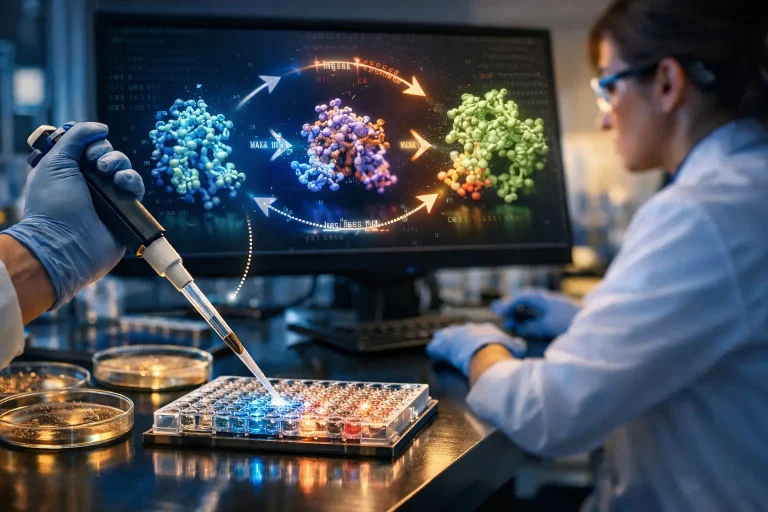

Optimization of epPCR: A Game-Changer in Mutagenesis Techniques
Introduction: The Power of Precision in Random Mutagenesis
Error-prone PCR (epPCR) is a powerful technique widely used in molecular biology and protein engineering to introduce random mutations in a DNA sequence. In fact, optimization of epPCR is critical to achieving controlled mutagenesis for studying gene function, evolving enzymes, or developing novel biomolecules.
Mutation, after all, is nature’s way of testing creativity. In the context of, protein engineering and directed evolution, epPCR stands out as a key tool for generating genetic diversity. However, here’s the catch—not all mutations are created equal. Without proper optimization, you might end up with too few mutations, biased nucleotide changes, or even failed reactions.
In the world of molecular biology, epPCR has emerged as one of the most powerful techniques to harness this creativity for good. Whether you’re a student exploring biotechnology, a researcher chasing protein function, or a startup innovating enzymes, understanding the optimization of epPCR can revolutionize your approach.
This post explores the optimization of epPCR—its critical factors, methodology, parameters, advanced techniques, and strategic advancements. Moreover,its covers its importance, applications, common pitfalls, and best practices to maximize efficiency and accuracy. Furthermore, let’s break down how this technique is transforming research and innovation in biotechnology and protein engineering.
“Optimizing epPCR is like tuning a race car—small adjustments make the difference between winning and crashing.”
What Is epPCR?
epPCR is a deliberate modification of the traditional PCR technique to introduce random mutations during DNA amplification. Unlike high-fidelity PCR, which minimizes errors, epPCR welcomes them.The optimization of epPCR means adjusting conditions so that errors occur at a controlled rate—enough to create diversity but not so much that the DNA becomes non-functional. It’s a fine balance, and when done right, the outcomes are incredibly powerful.
Detail study about epPCR visit, “Error-Prone PCR: A Comprehensive Guide to Mutation Generation“
Standard PCR vs. Optimized epPCR
| Feature | Standard PCR | Optimized epPCR |
| Goal | Accurate DNA replication | Controlled, high-yield mutagenesis |
| Fidelity | High (minimal errors) | Precisely tuned error rate |
| Key Adjustments | Standard buffer conditions | Custom Mg²⁺, Mn²⁺, dNTP ratios |
What is Optimization of epPCR?
Optimization of epPCR refers to the strategic adjustment of PCR reaction components and conditions to increase the mutation rate while maintaining sufficient amplification fidelity. In essence, the goal is to introduce a diverse array of mutations into the target DNA sequence without completely compromising the integrity of the DNA. However, here’s the deal: unoptimized error-prone PCR often results in:
- Too many lethal mutations
- Low mutation diversity
- Unpredictable error rates
That’s where optimization steps in. It fine-tunes the process for:
- Efficient mutagenesis
- Targeted variation
- Reliable outcomes
The optimization of epPCR increases the success rate of directed evolution experiments and accelerates protein engineering research.
Strategic Steps in Optimization of epPCR
- Select a suitable polymerase: Use a low-fidelity enzyme like Taq polymerase.
- Adjust dNTP concentrations: Create an imbalance among dATP, dTTP, dCTP, and dGTP.
- Include Mn2+ ions: Supplementing with MnCl2 increases error rate.
- Modify buffer conditions: Adjust MgCl2 and pH as necessary.
- Cycle number and annealing temp: Use moderate cycle numbers and slightly lower annealing temperatures.
- Template and primer quality: Use high-purity templates and primers to reduce nonspecific amplification.
Key Parameters for Optimization of epPCR
The optimization of epPCR revolves around fine-tuning several variables: such as;
Adjusting Magnesium Ion Concentration (MgCl₂)
- Mg²⁺ stabilizes DNA-polymerase binding but can increase fidelity if too high. Higher Mg²⁺ concentrations stabilize mismatched base pairings, thus increasing error rates. Optimized levels:
- Mg²⁺: 2–7 mM (varies by polymerase). Standard PCR: 1.5 mM
- Error-prone PCR: 4–7 mM
Tip: More isn’t always better—too much can cause non-specific amplification.
Manganese Ion Addition (MnCl₂)
- Manganese (Mn²⁺) is the key driver of mutations—introduces mismatches during replication. It is a game-changer for introducing errors. Even trace amounts (0.05–0.25 mM) significantly increase misincorporation.
Optimization Strategy: Use in combination with MgCl₂ for controlled mutagenesis.
Imbalanced dNTPs
Imbalanced dNTP concentrations can bias the polymerase into making more mistakes.
Example Setup:
| dATP | dCTP | dGTP | dTTP |
| 1 mM | 0.2 mM | 1 mM | 0.2 mM |
The imbalance contributes to base substitution errors.
Polymerase Choice
Taq DNA polymerase is the most common enzyme used due to its inherent low fidelity. Enzymes without proofreading activity are preferred.
Alternate Options: Thermus thermophilus and Tth DNA polymerases.
Cycle Number and DNA Template Amount
Too many cycles = too many random errors. Optimized protocols usually go for:
- 25–30 cycles
- 10–100 ng template DNA
Balance is key for maintaining target gene integrity.
Advanced Optimization Techniques
- Combinatorial Libraries with DNA Shuffling: After epPCR, shuffle DNA fragments to recombine beneficial mutations.
- Machine Learning-Guided Optimization: AI models predict optimal Mg²⁺/Mn²⁺ ratios for target mutation rates.
- CRISPR-Enhanced Mutagenesis: Combine epPCR with CRISPR to introduce targeted + random mutations.
Best Practices and Tips for Effective epPCR
To get the most from your epPCR optimization:
- Perform a pilot experiment with varying Mn2+ and dNTP ratios.
- Use gel electrophoresis to verify product size and quality.
- Sequence a subset of clones to estimate mutation frequency.
- Document and iterate—track every condition for reproducibility.
Running the Reaction
- Prepare master mix with adjusted Mg²⁺/Mn²⁺ and dNTPs.
- Run 30–35 cycles (denaturation: 94°C, annealing: 55–60°C, extension: 72°C).
- Verify mutation rate by sequencing 5–10 clones.
Here’s a concise protocol to guide you through the optimization of epPCR:
| Step | Component | Details | Purpose of Adjustment |
| 1 | Template DNA | 10–100 ng | |
| 2 | dNTPs | Imbalanced | Force mismatches |
| 3 | MgCl₂ | 4–7 mM | ↑ Misincorporation |
| 4 | MnCl₂ | 0.05–0.25 mM | ↑ Error rate |
| 5 | Taq Polymerase | 1–2 units | Better error control |
| 6 | Primer Pair | 0.2–0.4 µM | |
| 7 | Cycle Number | 25–30 | |
| 8 | Final Volume | 50 µL |
Troubleshooting Common Optimization Issues
While powerful, the optimization of epPCR presents several challenges:
- Balancing mutation rates: Too high a mutation rate can cause deleterious mutations, while too low might not produce desired variations.
- Polymerase selection: Standard Taq polymerase lacks proofreading but has biases; high-fidelity enzymes are less suitable.
- Template quality: Poor-quality templates can skew mutation profiles.
- Reaction condition variability: Buffer composition, dNTP imbalance, and Mg2+ concentration critically affect outcomes.
Even with optimization, you may encounter roadblocks. Here’s how to handle them:
Problems and Their Solution
Low Mutation Rate
- Solution:
- Increase Mn²⁺ (up to 0.5 mM).
- Use unequal dNTPs.
- Try a low-fidelity polymerase.
- Cause: Too few cycles, Solution: Increase cycle number slightly
Excessive GC Bias (A→G / T→C Dominance)
- Solution:
- Use Cadwell & Joyce’s method (balanced dNTPs + Mn²⁺).
- Switch to Mutazyme for more random errors.
Over-Mutated, Non-Functional DNA
- Solution:
- Reduce cycle number (25–30 cycles).
- Lower Mn²⁺ (0.1–0.3 mM).
No PCR product
- Cause: Excessive MnCl₂
- Solution:: Reduce MnCl₂ concentration
Too many non-specific bands
- Cause: High MgCl₂ or dNTP imbalance
- Solution: Titrate to optimal levels
Key Applications of Optimized epPCR
The optimization of epPCR has revolutionized the field of protein engineering. By introducing controlled mutations, researchers can evolve proteins with enhanced traits. Key applications include:
- Enzyme evolution for industrial catalysis
- Creation of antibody libraries
- Directed evolution in synthetic biology
- Engineering resistance to antibiotics
Advantages of epPCR over Site-Directed Mutagenesis
| Feature | epPCR | Site-Directed Mutagenesis |
| Randomness | High | Low |
| Library Size | Large | Small |
| Ease of Use | Moderate | High |
| Specificity | Low | High |
The optimization of epPCR makes it more versatile for discovering unexpected functional mutations.
Mistakes to Avoid When Working on Optimization of epPCR for Mutagenesis
- Overusing Mn2+: While it increases error rates, excess Mn2+ can cause severe template degradation.
- Ignoring primer design: Poorly designed primers can easily result in amplification failure, leading to inconsistent or non-reliable results
- Skipping controls: It’s essential to always include a non-mutated control to assess the efficiency of your mutation protocol.
- Neglecting library screening: Even with successful epPCR, without proper screening, beneficial mutations may be missed, ultimately limiting the value of your mutated library.
Future Perspectives
With rising interest in machine learning and high-throughput screening, more importantly, the combination of optimized epPCR and AI-based analysis tools is opening new horizons in synthetic biology and drug design. For instance, imagine designing enzymes with predictive precision—epPCR is the first step.
Final Thoughts: Why Optimization of epPCR is Worth the Effort
The optimization of epPCR is without a doubt a foundational skill for molecular biologists and bioengineers aiming to evolve biomolecules or explore genetic functions. In fact, a well-optimized protocol leads to rich mutant libraries, robust data, and high-impact discoveries. Moreover, with thoughtful planning and execution, you can harness the full potential of this powerful technique.
If you’re venturing into directed evolution, remember: optimizing epPCR isn’t just a technical requirement—it’s the key to unlocking biological innovation.Feel free to share this post, leave your comments below, or download our checklist for a quick epPCR optimization reference!
Key Takeaways
- Optimization of epPCR balances mutation frequency with functional integrity.
- Critical factors: Mg²⁺, Mn²⁺, dNTP ratios, enzyme choice, and cycle count.
- Mn²⁺ is the key driver of mutations—optimize between 0.2–0.5 mM.
- Unbalanced dNTPs force mismatches and increase diversity.
- 30–35 cycles is the ideal range for balanced mutagenesis.
- Avoid GC bias with Cadwell & Joyce’s method or Mutazyme.
- Applications: Protein engineering, functional genomics, directed evolution.
- With thoughtful optimization, epPCR becomes a reliable engine for innovation.
Frequently Asked Questions and Answers
What makes error-prone PCR a game-changer in protein engineering?
Indeed, error-prone PCR (epPCR) revolutionizes protein engineering by introducing random mutations. As a result, it accelerates the evolution of proteins with improved or entirely new functions.
How is epPCR different from traditional PCR?
In contrast to traditional PCR, which focuses on accurate DNA replication, epPCR is intentionally designed to create mutations. Consequently, it generates genetic variability crucial for protein evolution.
Why is optimizing epPCR critical for successful experiments?
Therefore, without proper optimization, epPCR may either introduce too many harmful mutations or too few to make a difference. A well-optimized protocol ensures a balanced mutation rate and retains functionality.
Which factors are key to epPCR optimization?
To achieve optimal results, factors such as Mg²⁺/Mn²⁺ concentrations, imbalanced dNTP ratios, number of thermal cycles, and choice of polymerase must be carefully adjusted. These elements collectively control the mutation rate.
How is epPCR used in real-world research?
As a matter of fact, optimized epPCR is widely used to evolve enzymes, generate antibiotic-resistant gene variants, study protein structure-function relationships, and even develop new therapeutic molecules.