
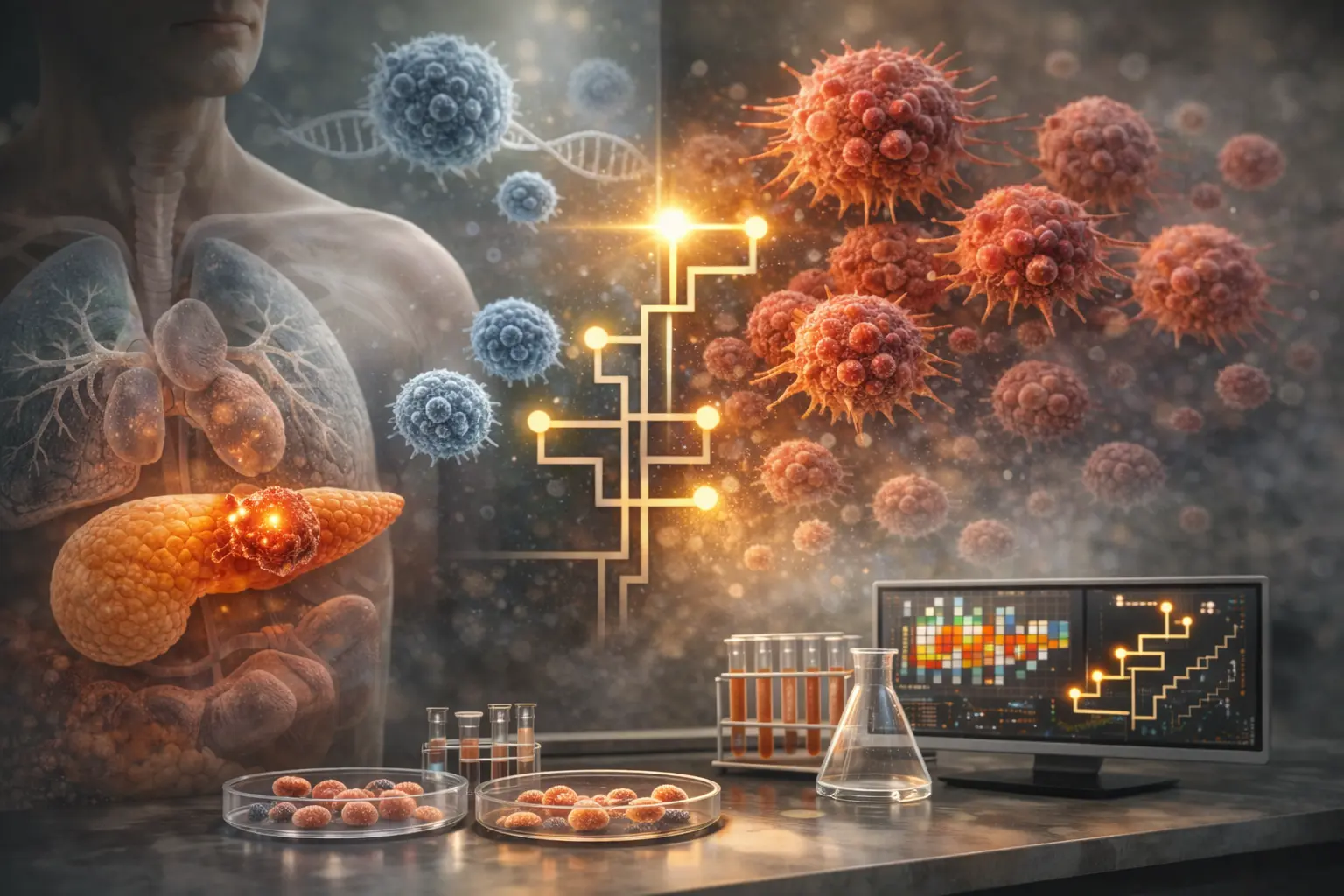
Pancreatic Cancer Evolution: A Single-Cell Breakthrough
Introduction
What drives pancreatic cancer evolution? For Susan, a 62-year-old former nurse diagnosed in 2023, that question became personal when her cancer returned within a year despite surgery and chemotherapy. Like most patients, she had few symptoms until the disease was advanced. Susan’s story is tragically familiar: pancreatic cancer remains one of the most lethal malignancies, with a five-year survival rate of just 13%. It is projected to become the second leading cause of cancer-related deaths in the USA.
For decades, scientists have studied the genetics of this deadly disease using bulk tumor samples, piecing together the average mutations present in a complex mixture of cells. However, this approach is like listening to a choir and trying to understand each individual singer’s voice; you hear the overall harmony, but you miss the soloists and the off-key performers that might drive the song in a new, dangerous direction.
A groundbreaking study published in Nature Genetics in 2026 has finally allowed us to hear those individual voices. Led by Haochen Zhang et al., this research offers an unprecedented, high-resolution view of pancreatic cancer evolution by analyzing the genomes of over 137,000 individual cancer cells. For patients like Susan, whose tumors returned despite aggressive treatment, such resolution may eventually explain why some cancers outsmart our best therapies.
What Was the Problem?
Previous studies on pancreatic cancer evolution have primarily relied on bulk sequencing. This method averages the genetic information from thousands of cells, which can obscure the critical differences between them.
Bulk Sequencing vs. Single-Cell Sequencing
Imagine you have a smoothie made of many different fruits. Bulk sequencing tells you that the smoothie contains “fruit” and maybe the average flavor profile. Single-cell sequencing is like separating that smoothie back into individual strawberry, banana, and blueberry cells to analyze each one separately. You can see exactly which fruits are present, how many of each exist, and discover a rogue chili pepper that completely changes the recipe!
Zhang et al. (2026) point out that clonal evolution occurs at the single-cell level. Because of this, bulk sequencing cannot reliably order the sequence of genetic events. It also cannot distinguish between mutations that occur together and those that are mutually exclusive in different cell populations. This lack of resolution has created significant gaps in our understanding. We still struggle to know how pancreatic cancer adapts, metastasizes, and becomes resistant to therapies.
The findings extend earlier evolutionary frameworks developed through the TRACERx initiative in lung cancer, but now at unprecedented single-cell resolution in pancreatic cancer. This contextual anchoring is crucial: we are not just learning about one tumor type, but refining our entire understanding of cancer evolution.
How Was the Study Conducted? A Journey to the Single-Cell Level
To overcome these limitations, the research team, led by Zhang et al. (2026), employed a sophisticated, multi-step approach that combined innovative sample collection with cutting-edge technology. Think of it as creating a detailed family tree for every single pancreatic cancer cell in a tumor. To understand how this new resolution reveals pancreatic cancer evolution, we must first examine the three-part approach the research team designed.
Assembling a Diverse “Tumor Library”
The researchers didn’t just look at one type of sample. Zhang et al. (2026) analyzed samples from 24 patients, which included:
- Early-stage tumors from surgical resections.
- Late-stage, metastatic tumors from rapid research autopsies.
- Longitudinal biopsies taken from the same patients before and after treatment.
This diverse collection allowed them to watch the movie of pancreatic cancer evolution, from its first act to its final scenes. In total, they gathered 30 primary tumor samples and 42 metastases.
Isolating the “Voices” (Single-Nucleus DNA Sequencing)
This is where the magic happened. Instead of blending all the cells together, the team used single-nucleus DNA sequencing (snDNA-seq).
What is snDNA-seq?
Single-nucleus DNA sequencing (snDNA-seq) is a technology that profiles the DNA from individual cell nuclei. Unlike traditional methods that analyze thousands of cells together, snDNA-seq reveals the unique genetic makeup of each single cell. This is crucial for understanding pancreatic cancer evolution because it allows researchers to detect rare cell populations, understand how different clones are related, and see exactly which mutations coexist in the same cell.
Zhang et al. (2026) designed a custom panel to target 253 genes known to be important in pancreatic cancer. They then sequenced the DNA from an astonishing 137,491 individual nuclei—one of the largest such datasets ever assembled for any solid tumor.
Building the “Family Trees” (Computational Analysis)
Raw data alone isn’t enough. Zhang et al. (2026) developed a new computational pipeline, including a tool called “fast-ConDoR,” to analyze the genetic information from each cell.
What is a Phylogenetic Tree?
In pancreatic cancer research, a phylogenetic tree is like a family tree for cancer cells. The “trunk” of the tree represents mutations that all cancer cells share—the earliest events in pancreatic cancer evolution. The “branches” represent later mutations found only in subsets of cells. By building these trees, researchers can trace the evolutionary history of a tumor and understand which mutations drive its growth and spread.
This software helped them build detailed phylogenetic trees for each patient’s tumor. By tracking which cells shared which mutations, they could trace the evolutionary history of the malignancy, identifying which mutations were “truncal” (present in the founding ancestor of all cancer cells) and which were “branch” events (occurring later in specific subclones). This analysis revealed that copy number variations (CNVs) appear to contribute substantially to the genetic diversity observed within pancreatic cancer tumors in this dataset.
What Did Researchers Discover? Three Key Insights into Pancreatic Cancer Evolution
The high-resolution data provided by Zhang et al. (2026) led to three major discoveries that refine our understanding of pancreatic cancer evolution and have direct implications for patient care.
The Malignancy May Escape KRAS Dependence
The KRAS gene is the most commonly mutated oncogene in pancreatic cancer, and new drugs targeting specific KRAS mutations are a major area of excitement. Several ongoing clinical trials of allele-specific inhibitors are based on the assumption that KRAS addiction is universal in this disease. However, Zhang et al. (2026) made a surprising discovery that challenges this assumption. In several patients, they found that a significant fraction of cancer cells (at least 10%) had actually lost the mutant KRAS allele.
What is KRAS Addiction?
Many cancers, including pancreatic cancer, depend on a mutant KRAS gene to survive and grow—this is called “oncogene addiction.” It’s like a car that can only run on a specific, high-octane fuel. New drugs are designed to cut off that fuel supply. However, Zhang et al. (2026) discovered that some cancer cells can switch to regular fuel or even put a different engine in the car, making the drug ineffective.
This raises a provocative question: does KRAS allele loss represent a common resistance pathway, or is it a rare evolutionary detour detectable only with ultra-deep sequencing? The study cannot yet answer this, but it opens the door for investigation. For patients like Susan, whose tumor returned within a year, such pre-existing resistant clones may have been present long before chemotherapy began, quietly expanding while treatment eliminated their more vulnerable neighbors.
Zhang et al. (2026) also observed other potential resistance mechanisms, like PIK3CA mutations, existing in tumors before any treatment was given. This implies that some pancreatic tumors may have a pre-existing “toolkit” for evading KRAS-targeted therapies—a finding with profound implications for how we sequence treatments.
The Timing of BRCA2 Inactivation Matters
Patients with inherited (germline) BRCA2 mutations are often grouped together for treatment with PARP inhibitors, a strategy validated by landmark trials like POLO. However, Zhang et al. (2026) discovered that this group is far from uniform. By tracing the evolutionary history in these patients, they found that the “second hit”—the inactivation of the remaining healthy BRCA2 gene copy—could happen at very different times.
In some patients, it was an early, foundational event, likely driving the initial development of the cancer through a pathway dominated by homologous recombination deficiency. In others, it happened later, after other classic driver mutations like KRAS and TP53 were already established, functioning more as an additive trait. Zhang et al. (2026) suggest that this difference in timing could significantly impact the tumor’s biology and its response to therapies like PARP inhibitors, pointing to a need for further stratification of patients beyond simple germline status.
Dr. Jacob Miller, a pancreatic cancer biologist at the Dana-Farber Cancer Institute not involved in the study, cautions: “While these findings are intriguing, the sample size of germline BRCA2 patients is small. The timing patterns need validation in larger cohorts before we can confidently use them to guide clinical decisions.” He adds that the variability observed may also reflect differences in how individual tumors tolerate genomic instability.
Continuous Pressure to Disable the TGF-β “Brake”
The TGF-β pathway normally acts as a brake on cell growth. Inactivating this pathway is a known step in cancer progression. But Zhang et al. (2026) showed that this isn’t a single event, but a continuous, evolving process. They observed “convergent evolution,” where different subclones within the same tumor found different ways to disable the TGF-β pathway. In some cases, a single lineage accumulated multiple hits to the pathway over time.
This relentless selection pressure to inactivate TGF-β signaling was strongly associated with invasion and metastasis. Zhang et al. (2026) found that these alterations were often subclonal in early-stage disease but became “truncal” (present in all cells) in late-stage, metastatic disease. This finding may explain the lack of clinical benefit observed when targeting TGF-β in numerous clinical trials conducted to date—by the time patients are treated, the pathway is already inactivated through diverse, redundant mechanisms.
Summary of Key Findings
The table below summarizes the three major discoveries from Zhang et al. (2026) and their implications for understanding disease evolution and treatment.
| Finding | Traditional View | Single-Cell Insight | Clinical Impact |
| KRAS Dependence | All cancer cells depend on mutant KRAS. | Some cells lose the mutant KRAS allele; pre-existing resistance mechanisms found. | Raises questions about KRAS inhibitor durability; suggests need for combination strategies. |
| BRCA2 Inactivation | All germline BRCA2 patients are similar. | Timing of BRCA2 “second hit” varies widely during tumor evolution. | Indicates need for better patient stratification; may explain variable PARP inhibitor responses. |
| TGF-β Pathway | Inactivation is a single step in progression. | Continuous, convergent evolution to disable the pathway during invasion/metastasis. | Explains why targeting TGF-β in clinical trials has been challenging; highlights evolutionary pressure. |
Why Does It Matter?
This study by Zhang et al. (2026) refines how we view the genomic landscape of pancreatic cancer. By moving from bulk analysis to single-cell resolution, the research reveals a tumor that is not a single, monolithic entity but a dynamic, evolving ecosystem.
- For Treatment: The findings challenge assumptions about KRAS inhibitor durability. If pre-existing resistant clones are common, combination therapies may be necessary from the start.
- For Patient Stratification: It challenges the notion that all patients with the same genetic mutation (e.g., germline BRCA2) are clinically equivalent. The timing and mechanism of key events in disease evolution may eventually guide more personalized treatment decisions.
- For Understanding Metastasis: The work on the TGF-β pathway provides a vivid picture of the constant evolutionary pressure cancer cells face as they invade new territories, leading to the repeated and varied inactivation of a critical growth brake.
Limitations to Consider
Despite its impressive resolution, the study has important limitations that warrant consideration. First, the targeted 253-gene panel, while comprehensive for known drivers, may miss novel genetic alterations outside these predefined genes. Whole-genome approaches, while lower depth, might capture unexpected drivers—or might reveal that CNVs are even more dominant than this panel suggests.
Second, single-nucleus sequencing introduces amplification biases that can affect detection of low-frequency variants. The authors acknowledge this and implemented rigorous filtering, but some true rare variants may have been excluded. It remains unclear whether findings like KRAS allele loss are biologically significant. They might instead be technical artifacts. Small sample sizes could have amplified these effects.
Third, the cohort size of 24 patients, while large for a single-cell study, limits generalizability. The findings are hypothesis-generating and require validation in larger, more diverse populations before they influence clinical practice.
Finally, the samples come from a single institution, potentially introducing referral and treatment biases. Multi-center studies will be essential to confirm these evolutionary patterns across different patient populations and treatment contexts.
Expert Context and Open Questions
The study challenges the long-standing assumption that KRAS addiction is universal in pancreatic cancer—an assumption underlying several ongoing clinical trials of allele-specific inhibitors. Dr. Miller further notes: “The real test will come when we can correlate these evolutionary patterns with clinical outcomes in patients receiving KRAS inhibitors. Do patients with detectable KRAS-loss clones progress faster? We don’t know yet.”
Several questions remain unanswered. Is KRAS allele loss a common event or a rare curiosity magnified by deep sequencing? Are CNVs truly dominant drivers of heterogeneity, or does the panel design simply make them easier to detect than point mutations? Could the TGF-β convergence simply reflect a larger target size—more genes in the pathway, more opportunities for mutation—rather than true selection pressure?
These questions don’t diminish the study’s contributions but frame them appropriately. Science advances through uncertainty as much as through discovery.
Conclusion: The Future of Research
Zhang et al. (2026) have provided the clearest view yet of the intricate evolutionary paths taken by pancreatic cancer. Their work demonstrates the immense power of single-cell technologies to uncover biological insights hidden by traditional methods. The study refines our understanding of how heterogeneity arises within a tumor, pointing to copy number variations as major drivers.
Future research should focus on confirming these findings in larger, multi-center cohorts and within controlled clinical trial settings. The ultimate goal is to translate this deep evolutionary understanding into practical strategies—for instance, predicting which BRCA2 patients will respond best to PARP inhibitors, or anticipating resistance mechanisms to KRAS-targeted drugs before they emerge.
For patients like Susan, and the thousands diagnosed each year, this knowledge brings hope that more effective, personalized treatments are on the horizon. Susan’s cancer eventually progressed through three lines of therapy. But when she enrolled in a clinical trial and researchers sequenced her tumor at single-cell resolution, they found exactly the kind of KRAS-loss clone Zhang et al. (2026) described—a tiny population that had expanded under treatment pressure. Too late for Susan, but perhaps in time for the next patient.
This study marks a significant step forward in our quest to understand and outsmart one of humanity’s most formidable foes. By seeing evolution in action at the single-cell level, we move closer to the precision medicine promised for so long.
For more in-depth articles on the genetic mechanisms driving cancer, explore our comprehensive Cancer Genetics section..
FAQs: Understanding Pancreatic Cancer Evolution
How does single-cell sequencing differ from traditional methods?
Single-cell sequencing examines each cell’s genome individually. In contrast, traditional bulk sequencing averages thousands of cells, masking rare mutations. Therefore, single-cell methods reveal hidden tumor diversity.
Why is pancreatic cancer so aggressive?
Pancreatic cancer evolves rapidly at the cellular level. Mutations accumulate in subclones, enabling resistance to therapy and promoting metastasis. Consequently, early detection is extremely challenging.
Can KRAS inhibitors fail in treatment?
Yes. Some tumor cells may lose mutant KRAS alleles naturally. As a result, these cells resist KRAS-targeted drugs. This explains why combination therapies might be more effective.
What role do copy number variations play?
Copy number variations create genetic diversity within tumors. They drive adaptation, invasion, and metastasis. Hence, understanding CNVs is crucial for personalized treatment strategies.
How does BRCA2 timing affect therapy?
The inactivation of BRCA2 occurs at different stages in tumor evolution. Early or late “second hits” impact tumor behavior and influence the effectiveness of PARP inhibitors.
Why is the TGF-β pathway important in pancreatic cancer?
The TGF-β pathway normally controls cell growth. Tumors continuously evolve to disable it. This enables invasion and metastasis, making therapy targeting the pathway more challenging.
Can single-cell studies improve patient outcomes?
Absolutely. They identify resistant clones before treatment. Therefore, clinicians can design personalized strategies, anticipate drug resistance, and enhance survival rates.
What future research is needed?
Larger multi-center studies must validate single-cell findings. Integrating these insights into clinical trials could transform precision medicine for pancreatic cancer.
Reference
Zhang, H., Sashittal, P., Karnoub, ER. et al. Genomic evolution of pancreatic cancer at single-cell resolution. Nat Genet (2026). https://doi.org/10.1038/s41588-025-02468-9


