
Epistasis: When One Gene Masks Another
Epistasis is a genetic interaction where the expression of one gene depends on the presence of one or more other genes. Not the same gene. A different one.
Quick Summary (TL;DR)
- Epistasis = one gene (epistatic locus) modifies or masks another (hypostatic locus).
- Not dominance (which operates within a single gene, between alleles).
- Classic example: Labrador coat color (E gene overrides B gene).
- Human relevance: Alzheimer’s risk, pharmacogenomics (warfarin dosing), cancer therapy (PARP inhibitors).
- Limitation: Detecting epistasis in human populations remains statistically challenging (Cordell, 2009).
Introduction
Here is a puzzle for you. Two people carry the exact same mutation linked to a genetic disease. One gets sick. But the other does not. How is that possible? Well, the surprising answer is epistasis. To put it simply, it is a concept that reminds us that genes are not lone warriors. Instead, they work in teams, in networks, constantly influencing each other.
For decades, we were taught genetics the simple way: dominant beats recessive. End of story. Butreal life is much messier. In fact, most of our traits do not follow such clean rules. As it turns out, epistasis is the rule, not the exception. What does that mean? It means that what a particular gene variant does often depends on what other variants are sitting elsewhere in your genome.
So, why does understanding epistasis matter? For several reasons. First, it can improve how we predict who will get a disease. Second, it helps explain how species evolve. Third, it even affects whether a medication will work for you. And on top of that, researchers are now using cutting-edge tools like machine learning to untangle these complex genetic conversations (Lundberg et al., 2023; Mackay, 2014).
Now, this guide will take you through epistasis from the ground up. We will cover molecular details, real-world examples, population-level effects, and even some debates still alive in the scientific community. Therefore, if you already know the basics of genetics, you are in good hands.
Without further ado, let us begin with a simple definition.
What ExactlyIs Epistasis? A Formal Definition
Let us start with the origin of the term. Epistasis comes from the Greek words epi meaning “upon” and stasis meaning “standing” (Phillips, 2008). So, it literally means “standing upon.” In genetics, this refers to a situation where the effect of a mutation at one gene depends on the presence or state of another gene.
Two technical terms help clarify this relationship:
- Epistatic locus: This is the gene whose product either changes or hides the effect of another gene.
- Hypostatic locus: This is the gene whose expression gets changed or silenced by the first gene.
In other words, epistasis describes a kind of hierarchy. Think of it this way: the epistatic locus sits functionally upstream-it comes first in line. The hypostatic locus, on the other hand, only gets to influence the final trait if the epistatic locus allows it.
Here is a simple example. Imagine a biochemical pathway. If an enzyme at the start of the pathway fails to produce a necessary ingredient, then any variations in enzymes further down the line become completely irrelevant. That is epistasis in action at the molecular level. In this case, the upstream gene is epistatic, and the downstream gene is hypostatic. For a visual breakdown of this genetic hierarchy, see Table 1.
| Table 1: Epistatic vs. Hypostatic Loci | ||
| Role | Definition | Labrador Example |
| Epistatic Locus | The gene that masks or modifies another | Gene E (pigment deposition) |
| Hypostatic Locus | The gene whose effect is hidden | Gene B (pigment color) |
| Table 1 illustrates the directional relationship. The epistatic locus overrides the hypostatic locus. Adapted from Griffiths et al. (2020). | ||
Molecular Mechanisms: How Epistasis Arises
Epistasis at the molecular level typically arises from three types of biological interactions (Phillips, 2008).
First, transcription factor cascades. One gene encodes a protein that activates or represses the transcription of many downstream genes. A loss-of-function mutation in that transcription factor silences all its targets simultaneously.
Second, signaling pathway dependencies. A cell surface receptor (Gene A) must receive an external signal. Only then can intracellular effectors (Gene B, Gene C) respond. If the receptor is non-functional, downstream effector status becomes irrelevant.
Third, enzyme-substrate relationships. The product of Gene A is a required substrate for the enzyme encoded by Gene B. No substrate. No reaction. Consequently, any mutation in Gene B has no observable effect if Gene A is already broken.
These mechanistic dependencies explain why epistasis is biologically pervasive. This is because proteins do not function in isolation; rather, they operate within densely connected networks of biochemical interaction.
Biological vs. Statistical Epistasis: A Critical Distinction
A crucial nuance often missing from introductory explanations separates biological epistasis from statistical epistasis. They are not the same thing (Phillips, 2008).
| Type | Definition | Implication |
| Biological epistasis | Direct molecular interaction between gene products | Proteins physically bind or function in the same pathway |
| Statistical epistasis | Non-additive interaction detected in a population model | The combined effect of two loci deviates from the sum of their individual effects |
Epistasis in the biological sense implies mechanism. Epistasis in the statistical sense implies only a mathematical deviation from additivity. Statistical interactions can arise without any direct molecular relationship. Two genes affecting the same trait through entirely separate pathways may appear statistically interactive if they influence a shared limiting resource.
Conversely, real biological epistasis can be statistically invisible when measured in populations with insufficient power or inappropriate genetic backgrounds. This disconnect between biological and statistical definitions remains an active area of research (Phillips, 2008).
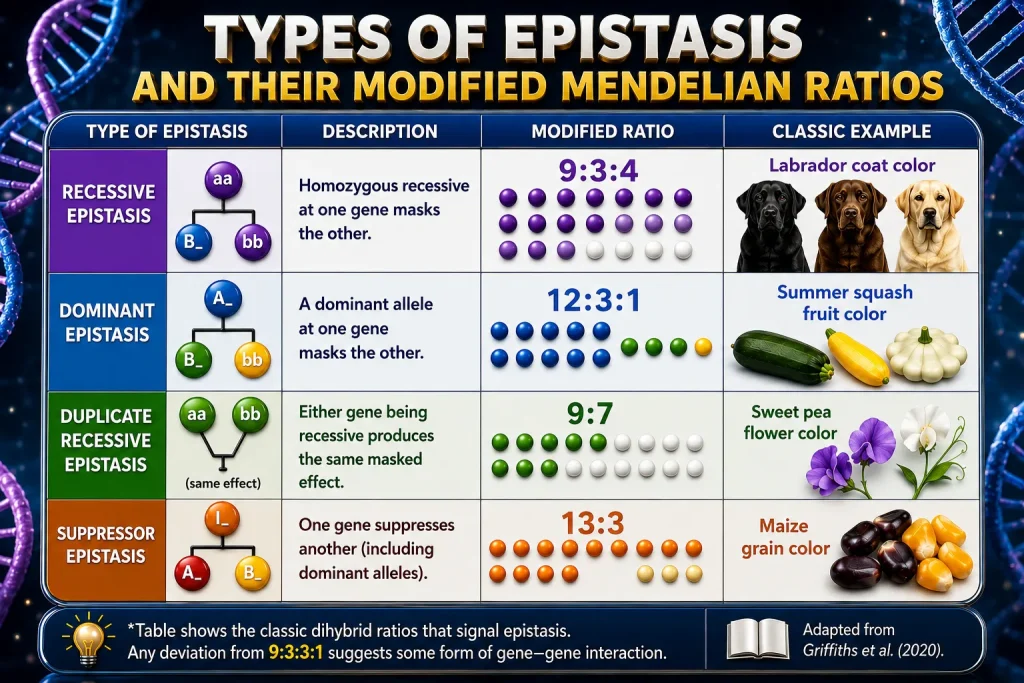
For a summary of classic epistasis types with their characteristic genetic ratios, see Table 2. and figure
| Table 2: Types of Epistasis and Their Modified Mendelian Ratios | |||
| Type of Epistasis | Description | Modified Ratio | Classic Example |
| Recessive epistasis | Homozygous recessive at one gene masks the other | 9:3:4 | Labrador coat color |
| Dominant epistasis | A dominant allele at one gene masks the other | 12:3:1 | Summer squash fruit color |
| Duplicate recessive epistasis | Either gene being recessive produces the same masked effect | 9:7 | Sweet pea flower color |
| Suppressor epistasis | One gene suppresses another (including dominant alleles) | 13:3 | Maize grain color |
| Table 2 shows the classic dihybrid ratios that signal epistasis. Any deviation from 9:3:3:1 suggests some form of gene-gene interaction. Adapted from Griffiths et al. (2020). | |||
Why Epistasis Matters: Real-World Examples
Epistasis is not merely a textbook curiosity. It has documented effects in human disease, animal breeding, agriculture, and evolution.
Epistasis in Humans: Disease Risk and Drug Response
In human medical genetics, epistasis explains why genotype does not always predict phenotype. Consider Alzheimer’s disease. The APOE4 allele represents a well-replicated risk factor. However, not all APOE4 carriers develop dementia. Using a machine learning GWAS platform, Lundberg et al. (2023) identified novel epistatic interactions involving genes such as TREM2 and UNC5C that modify Alzheimer’s disease risk, demonstrating that gene-gene interactions contribute significantly to disease susceptibility.
Epistasis also governs pharmacogenetic responses. Warfarin dosing, a classic example in clinical pharmacogenomics, depends on epistatic interactions between CYP2C9 (a metabolism gene) and VKORC1 (the drug target sensitivity gene). Neither gene alone predicts optimal dose as accurately as their combined interaction, and clinical guidelines now incorporate both genotypes to improve dosing accuracy (Johnson et al., 2017).
Epistasis in Animals: The Labrador Retriever
The Labrador coat color example remains the clearest pedagogical demonstration of recessive epistasis (Griffiths et al., 2020). Two genes interact hierarchically:
- Gene B (Color): B = black pigment, b = brown (chocolate).
- Gene E (Deposition): E = pigment can be deposited in fur, e = pigment cannot be deposited.
When a dog carries two copies of the recessive *e* allele (ee), no dark pigment reaches the fur. The genotype at Gene B becomes irrelevant. A dog with BB ee or Bb ee is yellow, not black or chocolate. Table 3 summarizes all genotypic combinations.
| Table 3: Labrador Coat Color Outcomes Explained by Epistasis | ||
| Genotype at Gene E (Deposition) | Genotype at Gene B (Color) | Resulting Coat Color |
| E_ (at least one functional E) | B_ (at least one B) | Black |
| E_ (at least one functional E) | bb | Chocolate |
| ee (non-functional deposition) | B_ or bb | Yellow |
| Table 3 demonstrates recessive epistasis. The ee genotype completely masks variation at Gene B (Griffiths et al., 2020). | ||
Epistasis in Agriculture: Crop Improvement
Plant breeders increasingly account for epistasis when selecting for complex traits such as drought tolerance. Using rice (Oryza sativa) as a model, Yadav et al. (2019) demonstrated that epistatic interactions between major-effect drought quantitative trait loci (QTLs) and genetic background loci significantly determine grain yield under drought stress. Similarly, Majumder et al. (2021) dissected epistatic interactions contributing to grain yield variability in rice under drought, showing that understanding these interactions improves breeding outcomes. A gene promoting deep root growth may show no benefit if a separate gene restricting root hair development is also present—an epistatic relationship that breeding programs must account for.
Epistasis in Evolution: Fitness Landscapes
Epistasis profoundly shapes evolutionary trajectories. In a rugged fitness landscape—a map from genotype to reproductive success—the effect of any single mutation depends on the genetic background in which it arises (Phillips, 2008).
A classic experimental demonstration involved the TEM-1 β-lactamase gene in bacteria. Weinreich et al. (2006) showed that of 120 possible mutational paths to cefotaxime resistance, only a handful were evolutionarily accessible because of sign epistasis. One mutation (G238S) is beneficial only after another mutation (E104K) has already occurred. The reverse order leads to a fitness valley. Epistasis thus constrains evolution. Historical contingency matters.
Synthetic Lethality: A Therapeutic Application
Synthetic lethality represents a clinically actionable form of epistasis. In this context, two mutations, each viable alone, become lethal when combined in the same cell. Importantly, this principle underlies PARP inhibitor therapy for BRCA-mutant cancers. Specifically, BRCA-mutant tumor cells cannot repair DNA through homologous recombination. As a result, inhibiting the alternative PARP-dependent repair pathway kills them selectively. In contrast, normal cells, with intact BRCA function, survive (Lord & Ashworth, 2017).
Epistasis vs. Dominance: A Necessary Clarification
A persistent source of confusion distinguishes epistasis from dominance. They operate at fundamentally different levels of genetic organization (Griffiths et al., 2020).
| Feature | Dominance | Epistasis |
| Number of genes | One | Two or more |
| Level of interaction | Allelic (within a locus) | Inter-locus (between different genes) |
| Molecular mechanism | One allele compensates for another | Sequential pathway dependency |
| Example | Brown eye allele dominant over blue | E gene masks B gene in Labradors |
Dominance asks which allele wins at a single locus. Epistasis asks which gene has the final say across different loci. They are not alternatives. They are orthogonal concepts.
Why Epistasis Is Difficult to Detect: Limitations and Challenges
Despite its biological pervasiveness, detecting epistasis in human populations remains methodologically challenging. Cordell (2009) provides an authoritative review of these limitations.
- Combinatorial complexity. With approximately 20,000 protein-coding genes, the number of possible pairwise interactions exceeds 200 million. Higher-order interactions increase this number astronomically. Exhaustively testing all combinations is computationally infeasible.
- Small effect sizes. On average, individual genetic variants explain only a tiny fraction of trait variance. Epistatic interactions typically have even smaller effect sizes, requiring enormous sample sizes for reliable detection.
- Multiple testing burden. Testing millions of interaction terms dramatically inflates false positive rates. Genome-wide significance thresholds for epistasis must be extremely stringent, reducing power.
- Underpowered studies. Most existing GWAS were designed to detect main effects, not interactions. Sample sizes adequate for main effect detection are often inadequate for epistasis (Cordell, 2009).
- Replication failures. Reported epistatic interactions frequently fail to replicate across independent cohorts. Whether this reflects true heterogeneity or statistical noise remains debated.
Consequently, although epistasis is biologically widespread, its contribution to heritability in human populations remains uncertain. Some quantitative geneticists argue that additive models capture most trait variance (Hill et al., 2008). Others contend that non-additive variance has been systematically underestimated due to methodological limitations (Zuk et al., 2012).
This debate is not resolved. The following section presents both perspectives.
Scientific Debate: How Much Does Epistasis Matter?
A balanced discussion of epistasis requires acknowledging competing scientific viewpoints (Mackay, 2014).
Perspective 1: Epistasis is pervasive and important. Proponents note that molecular pathways are inherently interactive. Most biological processes involve sequential reactions, protein complexes, and regulatory networks. Epistasis appears consistently in model organism studies (yeast, Drosophila, mice). The missing heritability problem may reflect undetected non-additive variance (Zuk et al., 2012).
Perspective 2: Additive variance dominates in natural populations. R.A. Fisher’s infinitesimal model, which assumes many small additive effects, successfully predicts responses to selection in plant and animal breeding. Empirical studies in humans suggest that additive genetic variance explains the majority of heritable trait variation. Epistatic variance, while present, may be relatively small (Hill et al., 2008).
A synthesized view: Both perspectives contain truth. Epistasis is biologically real and mechanistically important. However, its contribution to population-level heritability may be modest for many complex traits. The two claims are not contradictory. Biological interaction does not necessarily imply large statistical effect sizes in outbred populations (Mackay, 2014; Phillips, 2008).
Systems Biology Perspective: Networks and Emergence
Modern epistasis research increasingly adopts a systems biology framework. Genes are not isolated agents. They form interactomes—dense networks of physical and functional interactions (Mackay, 2014).
Several systems-level concepts are relevant:
- Robustness: Genetic networks often contain redundant pathways. A mutation in one gene may have no phenotypic effect because a paralogous gene compensates. This redundancy masks epistatic relationships.
- Canalization: Developmental systems evolve to produce consistent phenotypes despite genetic or environmental variation. Canalization represents buffering against epistatic effects.
- Modularity: Genes cluster into functional modules (e.g., signaling pathways, metabolic circuits). Epistasis tends to be stronger within modules than between them.
- Emergent properties: Phenotypes arise from collective network behavior, not from individual gene actions. Epistasis is the mathematical consequence of these emergent interactions.
Key Takeaways
- Epistasis describes genetic interactions where the effect of one locus depends on another (Phillips, 2008).
- Not dominance—a common confusion that this article aims to resolve (Griffiths et al., 2020).
- Molecular mechanisms include pathway dependencies, transcription cascades, and enzyme-substrate relationships (Phillips, 2008).
- Biological vs. statistical epistasis are distinct concepts (Phillips, 2008).
- Real-world examples span Alzheimer’s disease (Lundberg et al., 2023), Labrador coat color (Griffiths et al., 2020), antibiotic resistance (Weinreich et al., 2006), and cancer therapy (Lord & Ashworth, 2017).
- Detection remains challenging due to combinatorial complexity, small effect sizes, and statistical power limitations (Cordell, 2009).
- Scientific debate continues about how much phenotypic variance epistasis explains in natural populations (Hill et al., 2008; Zuk et al., 2012).
- Systems biology frames epistasis as a consequence of network robustness, modularity, and emergence (Mackay, 2014).
Conclusion
Epistasis is not an obscure exception to Mendelian genetics. In fact, it is a fundamental feature of genetic architecture. However, its importance must be stated with appropriate scientific restraint. For instance, epistatic interactions appear to be substantially more pervasive than early Mendelian models implied. Nevertheless, the extent to which they explain heritable variation in human populations remains an open research question (Hill et al., 2008; Zuk et al., 2012).
Fortunately, several conclusions are well-supported. First, epistasis is mechanistically widespread. Specifically, proteins function in pathways and networks, not in isolation (Phillips, 2008). Second, epistasis has documented clinical relevance, from pharmacogenetics to synthetic lethality (Johnson et al., 2017; Lord & Ashworth, 2017). Third, detecting epistasis in human GWAS is methodologically difficult, and therefore, reported interactions require cautious interpretation (Cordell, 2009).
That said, open questions remain. For example, how much non-additive variance exists for complex traits? Additionally, which study designs best detect epistasis? Finally, can machine learning overcome combinatorial challenges? Together, these questions define the frontier of epistasis research (Lundberg et al., 2023; Mackay, 2014).
For those interested, searching PubMed for “epistasis” along with a disease of personal relevance will retrieve current literature. Moreover, the field is advancing rapidly, driven by larger datasets, improved statistical methods, and systems-level thinking.
In summary, epistasis complicates simple genetic narratives. Yet, that complication reflects biological reality more accurately than idealized Mendelian ratios ever could.
FAQs
What is epistasis in simple terms?
Epistasis refers to a situation where the effect of one gene depends on the presence or activity of another gene. In some cases, one gene can mask or modify the effect of another gene, meaning the second gene’s influence is not expressed unless the first gene allows it to be visible (Griffiths et al., 2020).
How is epistasis different from dominance?
Dominance occurs between different alleles of the same gene, where one allele masks another. Epistasis, in contrast, involves interactions between different genes, where one gene modifies or suppresses the effect of another gene at a separate locus (Griffiths et al., 2020).
What are examples of epistasis in humans?
Several medically relevant traits involve gene–gene interactions. For instance, Alzheimer’s disease risk has been linked to interactions such as APOE4 × TREM2 and other loci identified through machine learning approaches (Lundberg et al., 2023). Another well-established example is warfarin dosing, which is influenced by interactions between CYP2C9 and VKORC1 genes (Johnson et al., 2017).
Why is epistasis difficult to detect?
Detecting epistasis is challenging due to the enormous number of possible gene–gene combinations, typically small effect sizes, and the statistical burden of multiple testing. In addition, many studies lack sufficient statistical power, making true interactions difficult to identify reliably (Cordell, 2009).
Do all geneticists agree on the importance of epistasis?
No, there is ongoing debate. Some researchers emphasize that epistasis plays a fundamental role in shaping biological systems, while others argue that additive genetic models explain most heritable variation at the population level. Both viewpoints are supported by empirical evidence, depending on the trait and analytical framework considered (Hill et al., 2008; Zuk et al., 2012).
What is synthetic lethality?
Synthetic lethality occurs when two genetic mutations that are individually non-lethal become lethal when combined. This concept has important applications in cancer therapy, particularly in the development of PARP inhibitors that target tumor-specific genetic vulnerabilities (Lord & Ashworth, 2017).
References
Foundational & Textbook Sources
- Griffiths, A. J. F., Doebley, J., Peichel, C., & Wassarman, D. A. (2020). Introduction to genetic analysis (12th ed.). W. H. Freeman and Company.
Methodological & Detection Challenges
- Cordell, H. J. (2009). Detecting gene–gene interactions that underlie human diseases. Nature Reviews Genetics, 10(6), 392–404. https://doi.org/10.1038/nrg2579 (Institutional access may be required)
Conceptual & Theoretical Frameworks
- Phillips, P. C. (2008). Epistasis—the essential role of gene interactions in the structure and evolution of genetic systems. Nature Reviews Genetics, 9(11), 855–867. https://doi.org/10.1038/nrg2452 (Institional Access may be required)
- Mackay, T. F. (2014). Epistasis and quantitative traits: using model organisms to study gene-gene interactions. Nature Reviews Genetics, 15(1), 22–33. https://doi.org/10.1038/nrg3627 (Institional Access may be required)
Additive vs. Non-Additive Variance (The Heritability Debate)
- Hill, W. G., Goddard, M. E., & Visscher, P. M. (2008). Data and theory point to mainly additive genetic variance for complex traits. PLOS Genetics, 4(2), e1000008. https://doi.org/10.1371/journal.pgen.1000008
- Zuk, O., et al. (2012). The mystery of missing heritability: Genetic interactions create phantom heritability. Proceedings of the National Academy of Sciences, 109(4), 1193–1198. https://doi.org/10.1073/pnas.1119675109
Human Disease & Pharmacogenomics
- Johnson, J., Caudle, K., Gong, L., Whirl-Carrillo, M., Stein, C., Scott, S., Lee, M., Gage, B., Kimmel, S., Perera, M., Anderson, J., Pirmohamed, M., Klein, T., Limdi, N., Cavallari, L. & Wadelius, M. (2017). Clinical Pharmacogenetics Implementation Consortium (CPIC) Guideline for Pharmacogenetics-Guided Warfarin Dosing: 2017 Update. Clinical Pharmacology & Therapeutics, 102, 397–404. https://doi.org/10.1002/cpt.668
- Lundberg, M., Sng, L.M.F., Szul, P. et al. (2023). Novel Alzheimer’s disease genes and epistasis identified using machine learning GWAS platform. Scientific Reports, 13, 17662. https://doi.org/10.1038/s41598-023-44378-y
Cancer & Synthetic Lethality
- Lord, C. J., & Ashworth, A. (2017). PARP inhibitors: Synthetic lethality in the clinic. Science, 355(6330), 1152–1158. https://doi.org/10.1126/science.aam7344 (Institutional access may be required)
Agriculture & Crop Improvement
- Yadav, S., Sandhu, N., Majumder, R.R. et al. (2019). Epistatic interactions of major effect drought QTLs with genetic background loci determine grain yield of rice under drought stress. Scientific Reports, 9, 2616. https://doi.org/10.1038/s41598-019-39084-7
- Majumder, R. R., Sandhu, N., Yadav, S., Catolos, M., Cruz, M. T. S., Maturan, P. C., Hassan, L., Hossain, M. A., & Kumar, A. (2021). Genetic Dissection of Epistatic Interactions Contributing Grain Yield Variability in Rice under Drought. Current Genomics, 22(6), 468–483. https://doi.org/10.2174/1386207324666210713112127
Experimental Evolution & Fitness Landscapes
- Weinreich, D. M., et al. (2006). Darwinian evolution can follow only very few mutational paths to fitter proteins. Science, 312(5770), 111–114. https://doi.org/10.1126/science.1123539 (Institutional access may be required)