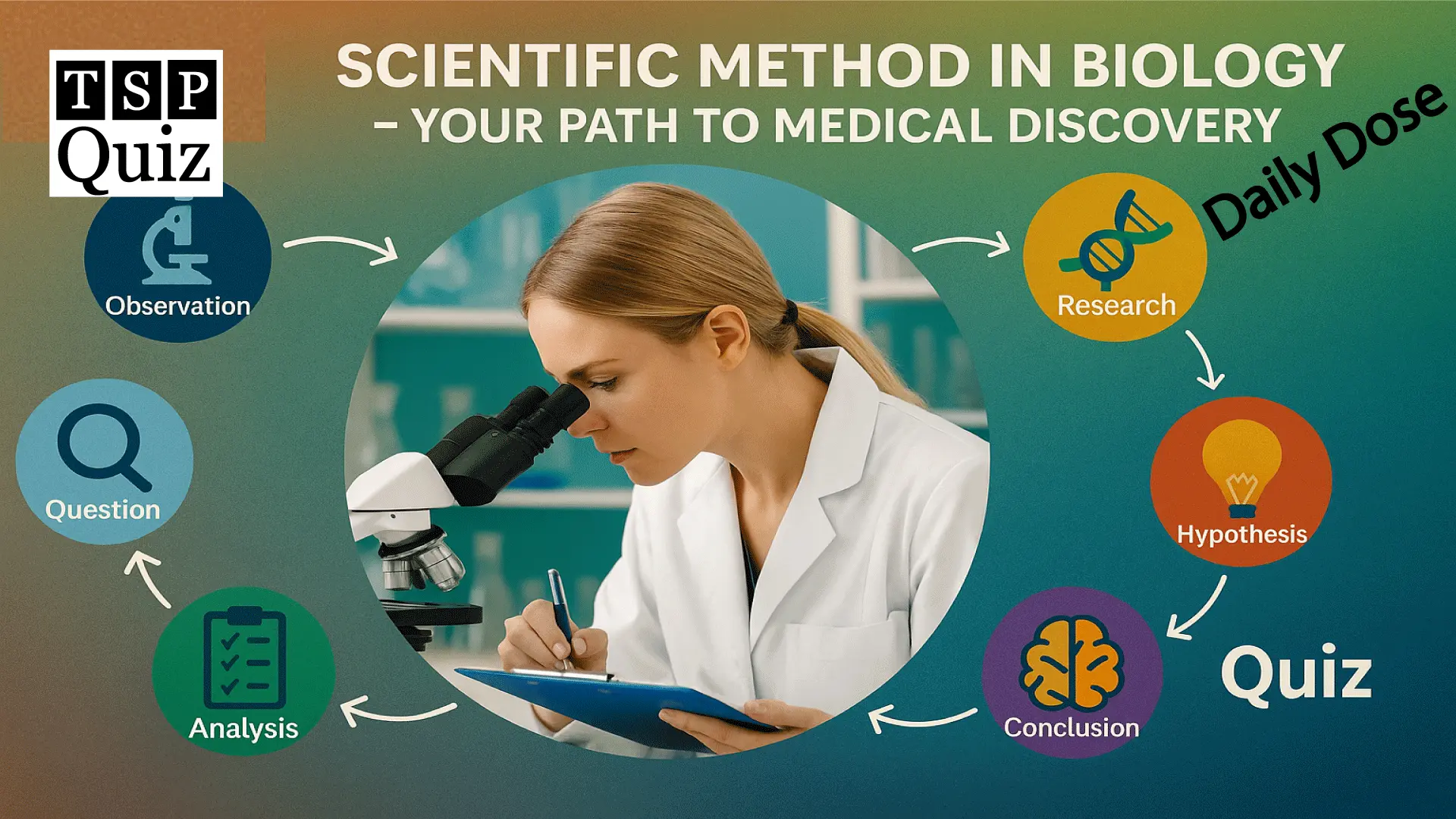
Scientific method in biology diagram with observation, question, research, hypothesis, analysis, and conclusion steps, featuring a scientist using a microscope for medical exam preparation.

Scientific Method Quiz: High-Yield Biology MCQs for Medical School Prep

Share This Post:

Attempt “Scientific Method Quiz”

Ready to test your understanding? Start the Scientific Method Quiz now and challenge your biology knowledge!

Scientific Method Quiz: High-Yield Biology MCQs for Medical School Prep

Click Here for Quiz Instructions 

Quiz Score Guide

Score Feedback Try Again?
16–20 correct Excellent understanding Optional
11–15 correct Good, needs slight review Recommended
6–10 correct Fair, review needed Strongly recommended
Below 6 Poor, revisit the topic Must retake

1 / 20

1)

How is a scientific theory different from a hypothesis?

2 / 20

2) Which organelle is responsible for energy production in a cell?

3 / 20

3)

A researcher wants to test if a new drug improves memory. Which group should receive a placebo?

4 / 20

4) Deduction in scientific methods refers to:

5 / 20

5)

A scientist observes that patients with higher sugar intake show symptoms of fatigue. What is the most appropriate hypothesis?

6 / 20

6)

A student claims: “The sun rises because the rooster crows.” What logical flaw is this?

7 / 20

7)

Which best explains the interdisciplinary nature of biology in medical science?


8 / 20

8)

If enzyme activity decreases at high temperatures, what deduction can be made?

9 / 20

9)

Which of the following is not a part of the scientific method?

10 / 20

10)

A scientist tests two fertilizers on plant growth and observes the following average growth: Fertilizer A – 12 cm; Fertilizer B – 20 cm. What can be concluded?

11 / 20

11)

If experimental data contradict the hypothesis, what should a scientist do?


12 / 20

12)

Which of the following is a common misconception about hypotheses?

13 / 20

13)

Which of the following defines a hypothesis?

14 / 20

14)

Why is replication important in scientific experiments?

15 / 20

15)

Which of the following best represents an example of qualitative observation?

16 / 20

16)

A new cancer drug shrinks tumors in mice but fails in human trials. What is the next logical step?

17 / 20

17)

What is the correct sequence of steps in the scientific method?

18 / 20

18)

In an experiment testing plant growth, which is the dependent variable?

19 / 20

19)

Which branch of biology deals with the classification of organisms?

20 / 20

20)

Why is it essential to change only one variable in a controlled experiment?

Your score is

The average score is 10%

0%

Note: For More Biology Quizzes, Visit: Genetics Quizzes and Assessments

Scientific Method Quiz: Top 5 Most Asked Questions Answered

What are the 7 steps of the scientific method?

The seven steps are: ObservationQuestionResearchHypothesisExperimentAnalysis, and Conclusion. Scientists begin by observing a phenomenon and asking a question. After reviewing existing knowledge, they propose a testable hypothesis. Controlled experiments are then performed. Data is analyzed, and conclusions are drawn. This process promotes accuracy, objectivity, and reproducibility in science.

Why is the scientific method important in medicine?

Medical science depends on accuracy and safety. The scientific method ensures treatments are evidence-based, not guesswork. For example, before approving a drug, researchers conduct clinical trials to test effectiveness and side effects. This structured method reduces human error, builds patient trust, and improves long-term health outcomes through data-driven discoveries.

What is a hypothesis in biology?

hypothesis is a statement predicting a relationship between variables. It must be clear and testable. For instance, “Increasing sunlight will enhance photosynthesis in plants.” Hypotheses are the basis for experimentation and guide scientists in collecting relevant, measurable data to prove or disprove their assumptions.

How can students apply the scientific method in biology labs?

Students practice it by identifying a question, proposing a hypothesis, designing experiments, and analyzing results. It teaches critical thinking, control of variables, and accurate data recording. This hands-on approach prepares them for real research or clinical trials in future medical or biological careers.

What is the difference between a hypothesis and a theory?

hypothesis is an initial idea needing testing. Scientists develop a theory as a broader explanation after repeating experiments and obtaining consistent results. While hypotheses remain temporary, strong evidence leads the scientific community to widely accept theories like cell theory or evolution.

Share This Post:

Similar Posts