Darwin’s Evolution Challenge – From Fossils to Finches
Attempt the Quiz ( Darwin’s Evolution Challenge)
Step into the wild world of evolution—attempt the quiz and conquer Darwin’s Evolution Challenge!
Darwin’s Evolution Challenge: Top FAQs from Fossils to Finches
Who proposed the theory of natural selection in evolution?
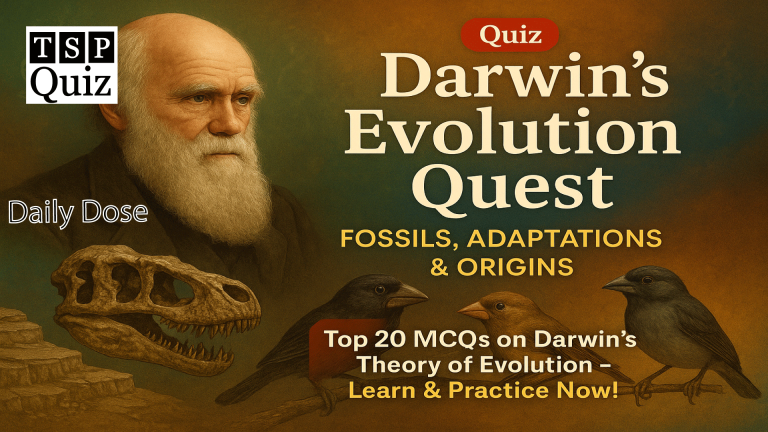
Charles Darwin introduced the theory of natural selection. He explained that species evolve gradually when individuals with favorable traits survive and reproduce. Over generations, these traits become more common. This simple yet powerful idea transformed our understanding of life, species change, and biological diversity across the planet.
What are homologous structures and why are they important in evolutionary biology?
Homologous structures are anatomical features found in different species that share a similar structure but may serve different functions. For example, a human hand, a whale’s flipper, and a bat’s wing have the same basic bone layout. These similarities provide strong evidence that these species evolved from a common ancestor, supporting evolutionary theory.
Why are transitional fossils considered critical evidence for evolution?
Transitional fossils help scientists trace the evolutionary journey of organisms. These fossils show traits of both ancestral and modern species. For example, fossils of early whales with hind limbs show their descent from land animals. Therefore, transitional fossils confirm gradual evolutionary change over time, reinforcing Darwin’s theory.
What is artificial selection and how does it relate to natural selection?
Artificial selection is the human-led process of breeding plants or animals for desired traits—like tastier fruits or docile pets. Unlike natural selection, which is driven by the environment, artificial selection is intentional. Darwin studied this concept in pigeons and used it to illustrate how selection—natural or artificial—can cause species to change over generations.
How did Darwin’s finch observations on the Galápagos Islands support natural selection?
Darwin observed that finches on different islands had beak shapes adapted to their specific food sources. Some had long, narrow beaks for insects, while others had thick beaks for seeds. These observations demonstrated that favorable traits improve survival and reproduction, leading to gradual changes in species through natural selection.