
AI in Genomic Medicine: Core Technologies Explained
Introduction: Why AI in Genomic Medicine Matters Now
Artificial intelligence in genomic medicine (AI in Genomic Medicine) is no longer a futuristic concept—it is actively transforming how we diagnose rare diseases and hereditary cancers today. Clinical genomics is entering a new era. However, the limiting factor is no longer sequencing data generation. Instead, it is the efficient and accurate interpretation of genomic information (Dara et al., 2025; Duong & Solomon, 2025). Meanwhile, whole-genome and whole-exome sequencing identify millions of genetic variants from a single individual. Consequently, these datasets create analytical demands that often exceed the capacity of traditional manual workflows (Solomon, 2026; Li et al., 2026).
Artificial intelligence has emerged as a powerful solution to this challenge (Changalidis et al., 2026).Modern AI systems perform multiple genomic tasks efficiently. For example, they prioritize clinically relevant variants and extract phenotypic information from electronic health records. Additionally, they summarize scientific literature, predict variant pathogenicity, and assist clinicians in identifying potential diagnoses (Duong & Solomon, 2025; Li et al., 2026). As a result, these capabilities can shorten diagnostic timelines. Moreover, they improve consistency and efficiency across genomic laboratories (Finlayson, 2026; Stein et al., 2025).
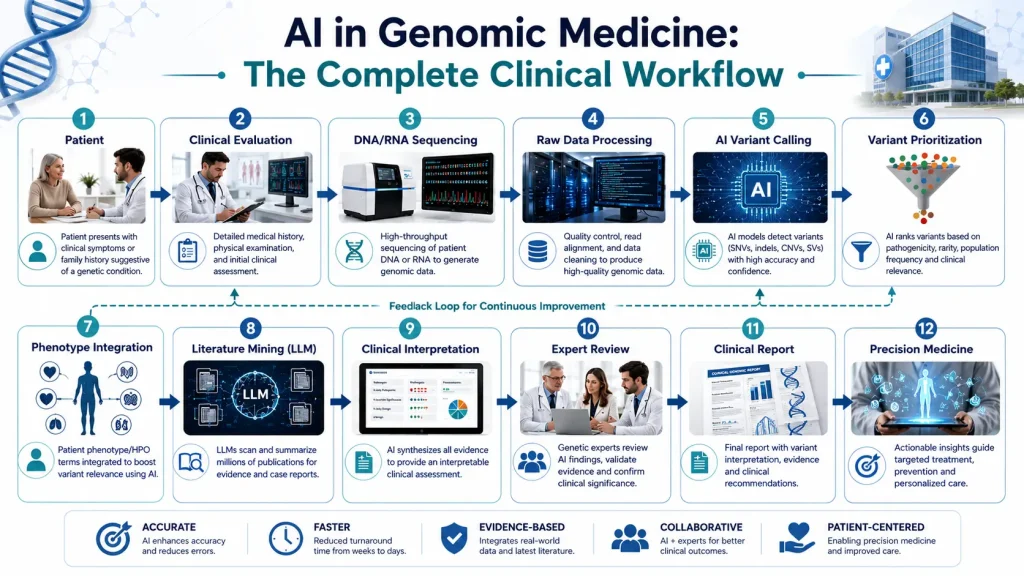
This post focuses on understanding the core AI technologies transforming genomic medicine and how they are applied across the clinical workflow. Subsequent posts in this series address implementation strategies and future directions. For a comprehensive overview of the complete diagnostic pathway, refer to Figure 1, which illustrates the sequential progression from patient presentation through to precision medicine delivery.
How AI help in Genetic Diagnostic. Please see our post “AI Genetic Diagnosis: Can a Machine Really Spot the One Faulty Gene?“
Key Takeaways
- Artificial intelligence encompasses diverse technologies including machine learning, deep learning, large language models, computer vision, natural language processing, and foundation models—each suited to specific genomic applications.
- AI in genomic medicine enhances every stage of the diagnostic pathway, from processing raw sequencing data to generating clinically actionable reports.
- Foundation models represent the next generation of AI, capable of integrating multiple biomedical data types within a unified analytical framework.
- Current evidence demonstrates that AI can substantially improve variant prioritization, phenotype analysis, literature review, and clinical workflow efficiency (Kim.
- AI functions most effectively as a clinical decision-support system that augments—not replaces—the expertise of geneticists, molecular pathologists, and laboratory scientists (Finlayson, 2026; Kim et al., 2024).
AI in Genomic Medicine: The Complete Clinical Workflow
The AI Toolkit: Core Technologies Driving Genomic Medicine
Artificial intelligence encompasses a broad collection of computational techniques rather than a single technology (Changalidis et al., 2026; Solomon, 2026). Within genomic medicine, each AI approach addresses a specific analytical challenge, ranging from variant interpretation and phenotype recognition to clinical documentation and therapeutic prediction (Duong & Solomon, 2025; Li et al., 2026). Selecting the appropriate methodology depends on the nature of the genomic data, the clinical objective, and the complexity of the problem being addressed (Kim et al., 2024; Stein et al., 2025).
Understanding the strengths and limitations of these technologies enables clinicians and healthcare administrators to identify the most appropriate tools for different stages of the genomic workflow (Changalidis et al., 2026; Al Souleiman & Al Souleiman, 2026). While some methods excel at recognizing patterns in DNA sequences, others are designed to interpret medical images, analyze electronic health records, or generate clinically meaningful summaries from large volumes of scientific literature (Li et al., 2026; Gurovich et al., 2019).
For a detailed comparison of these technologies, see Table 1, which summarizes their primary functions, genomic applications, key strengths, and limitations.
Comparison of AI Technologies in Genomic Medicine
| Technology | Main Function | Genomic Application | Key Strength | Key Limitation |
| Machine Learning (RF, SVM) | Learning patterns from genomic data | Variant prioritization, pathogenicity prediction | Highly interpretable; clinicians can understand prediction drivers (Kim et al., 2024) | Struggles with highly complex, non-linear relationships |
| Deep Learning (CNNs) | Extracting complex biological relationships | Image-based phenotype analysis, variant calling | Exceptional pattern recognition in structured data like images (Gurovich et al., 2019) | Extremely data-hungry and computationally expensive to train |
| Large Language Models (LLMs) | Transforming clinical knowledge management | Literature synthesis, report generation, NLP for clinical notes | Superior context-aware reasoning; processes unstructured text (Li et al., 2026) | Risk of hallucination; generates probabilistic, not deterministic, outputs |
| Computer Vision | Interpreting medical images and phenotypes | Facial phenotype recognition, digital pathology | Identifies subtle morphological features (Gurovich et al., 2019) | Requires large annotated image datasets |
| Natural Language Processing | Unlocking clinical information | Phenotype extraction, HPO term identification | Converts unstructured text to structured data (Li et al., 2026) | Performance depends on documentation quality |
| Foundation Models | Unified approach to biomedical intelligence | Multi-omics integration, cross-domain prediction | Generalizable learning; fine-tuned for diverse tasks (Changalidis et al., 2026; Solomon, 2026) | Early-stage validation; limited clinical evidence |
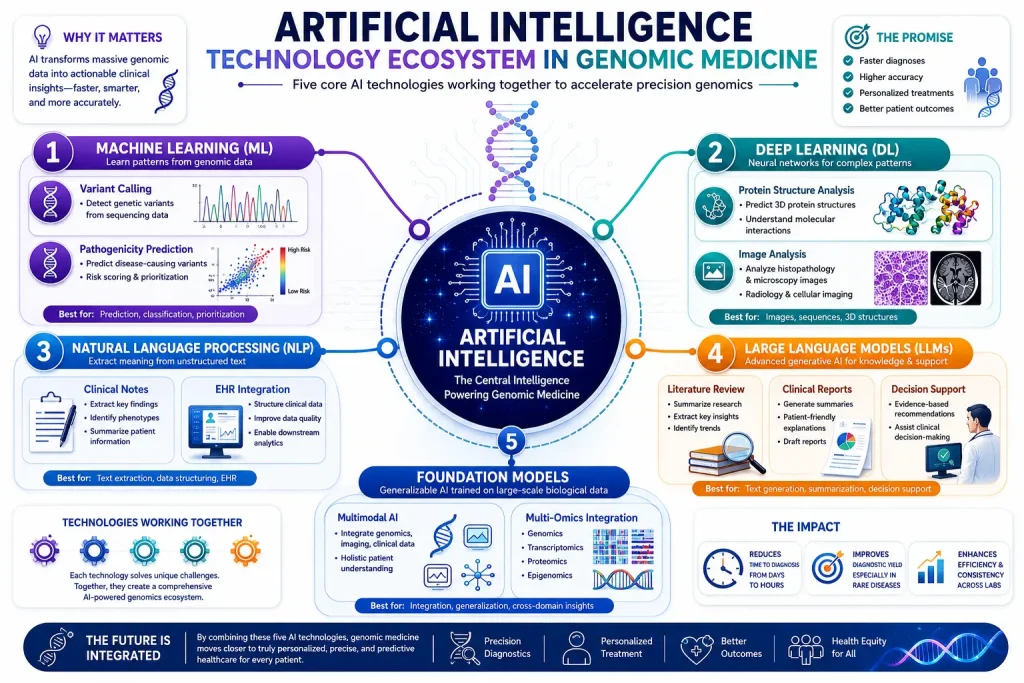
AI Technology Ecosystem in Genomic Medicine
Machine Learning: Learning Patterns from Genomic Data
Machine learning (ML) forms the foundation of most contemporary AI applications in genomics (Kim et al., 2024; Stein et al., 2025). Instead of relying on manually programmed decision rules, ML algorithms learn statistical relationships directly from large datasets (Changalidis et al., 2026). By identifying recurring patterns within genomic and clinical information, these models can generate predictions for previously unseen cases (Duong & Solomon, 2025; Li et al., 2026).
In genomic medicine, machine learning has become indispensable for prioritizing pathogenic variants, estimating disease risk, classifying inherited disorders, and predicting treatment response (Kim et al., 2024; Stein et al., 2025). Algorithms continuously refine their predictive capability as additional high-quality training data become available, allowing performance to improve over time (Changalidis et al., 2026; Advancing genome-based precision medicine, 2025).
The effectiveness of any machine learning model, however, depends heavily on the quality, diversity, and representativeness of the data used during development (Ilić & Sarajlija, 2025; O’Connor & McVeigh, 2025). Poor-quality or biased datasets inevitably lead to inaccurate predictions, regardless of algorithmic sophistication (Duong & Solomon, 2025; Finlayson, 2026).
Deep Learning: Extracting Complex Biological Relationships
Deep learning represents a specialized branch of machine learning that employs multi-layered artificial neural networks to analyze highly complex biological data (Changalidis et al., 2026; Gurovich et al., 2019). These architectures automatically identify intricate patterns that would be extremely difficult—or even impossible—for traditional statistical methods to detect (Solomon, 2026; Li et al., 2026).
Within genomic medicine, deep learning has demonstrated remarkable success in several areas, including DNA sequence interpretation, variant pathogenicity prediction, phenotype recognition, medical image analysis, and protein structure modeling (Gurovich et al., 2019; Changalidis et al., 2026). Because these models learn hierarchical biological features directly from raw data, they require minimal manual feature engineering compared with conventional machine learning approaches (Duong & Solomon, 2025; Stein et al., 2025).
Despite their impressive predictive performance, deep learning systems often operate as “black boxes,” making it difficult to understand the reasoning behind individual predictions (Kim et al., 2024; Al Souleiman & Al Souleiman, 2026). This lack of interpretability has become one of the major barriers to widespread clinical adoption and has stimulated considerable interest in explainable AI methodologies (Kim et al., 2024; Finlayson, 2026).
Large Language Models: Transforming Clinical Knowledge Management
Large Language Models (LLMs) constitute one of the most rapidly evolving branches of artificial intelligence (Li et al., 2026; Finlayson, 2026). Trained on enormous collections of biomedical publications, clinical guidelines, textbooks, and other textual resources, these models are capable of understanding and generating human language with remarkable fluency (Solomon, 2026; Changalidis et al., 2026).
Rather than replacing specialist expertise, LLMs enhance clinician productivity by supporting literature review, drafting clinical documentation, summarizing complex research findings, extracting relevant information from medical records, and assisting with educational activities (Li et al., 2026; Finlayson, 2026). In genomic medicine, these capabilities substantially reduce the administrative burden associated with reviewing scientific evidence and preparing diagnostic reports (Duong & Solomon, 2025; Everton et al., 2026).
Nevertheless, current LLMs remain susceptible to factual inaccuracies, fabricated references, prompt sensitivity, and overconfident responses (Li et al., 2026; Finlayson, 2026). Consequently, every AI-generated recommendation must undergo careful review by qualified healthcare professionals before being incorporated into patient care (O’Connor & McVeigh, 2025; Al Souleiman & Al Souleiman, 2026).
Computer Vision: Interpreting Medical Images and Phenotypes
Computer vision enables artificial intelligence systems to analyze visual information obtained from medical images and clinical photographs (Gurovich et al., 2019; Changalidis et al., 2026). By identifying subtle morphological features that may escape human observation, these algorithms provide valuable support for diagnosing genetically determined disorders (Solomon, 2026; Duong & Solomon, 2025).
Applications include facial phenotype recognition in rare diseases, digital pathology, dermatological assessment, retinal imaging, radiology, and microscopic analysis (Gurovich et al., 2019; Ilić & Sarajlija, 2025). In many cases, computer vision assists clinicians by highlighting abnormalities that warrant further investigation rather than providing an autonomous diagnosis (Changalidis et al., 2026; Solomon, 2026).
The greatest clinical value is achieved when image analysis is combined with genomic sequencing data, family history, and phenotypic information to generate a comprehensive diagnostic assessment (Duong & Solomon, 2025; Advancing genome-based precision medicine, 2025).
Natural Language Processing: Unlocking Clinical Information
Healthcare organizations store enormous quantities of valuable information within unstructured clinical documents, including physician notes, pathology reports, discharge summaries, laboratory interpretations, and genetic counseling records (Li et al., 2026; Everton et al., 2026). Natural Language Processing (NLP) enables computers to extract clinically meaningful information from these free-text documents (Duong & Solomon, 2025; Changalidis et al., 2026).
In genomic medicine, NLP facilitates automated phenotype extraction, identification of Human Phenotype Ontology (HPO) terms, literature mining, and integration of clinical observations into variant interpretation pipelines (Li et al., 2026; Everton et al., 2026). These capabilities reduce manual data abstraction while improving the consistency and completeness of clinical information available for downstream analysis (Solomon, 2026; Advancing genome-based precision medicine, 2025).
By converting narrative clinical documentation into structured data, NLP also enhances interoperability between electronic health records, laboratory information systems, and AI-powered decision-support platforms (O’Connor & McVeigh, 2025; Al Souleiman & Al Souleiman, 2026).
Foundation Models: A Unified Approach to Biomedical Intelligence
Recent advances in artificial intelligence have led to the development of foundation models—large-scale neural networks trained on diverse biomedical datasets before being adapted to specific clinical applications (Changalidis et al., 2026; Solomon, 2026). Unlike conventional algorithms designed for a single task, foundation models acquire broad biological knowledge that can subsequently be transferred to numerous downstream problems with relatively limited additional training (Al Souleiman & Al Souleiman, 2026; Duong & Solomon, 2025).
Within genomics, these models are beginning to integrate DNA sequence information, gene expression profiles, protein structure, medical imaging, electronic health records, and scientific literature into unified computational frameworks (Changalidis et al., 2026; Solomon, 2026). Such multimodal learning enables AI systems to recognize complex biological relationships that extend across traditionally separate data sources (Duong & Solomon, 2025; Advancing genome-based precision medicine, 2025).
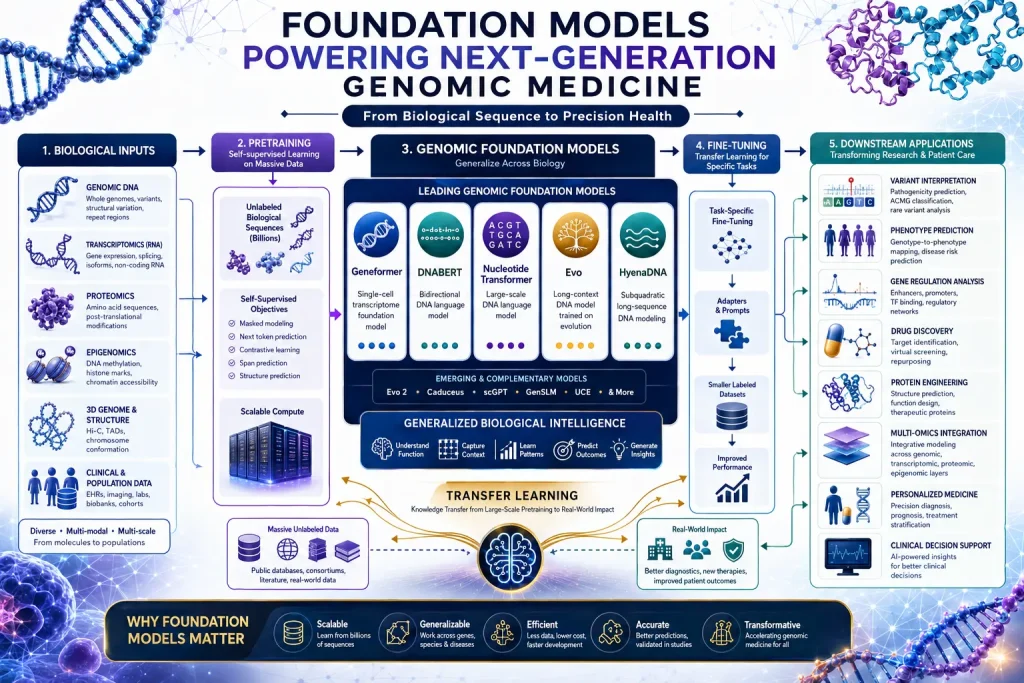
For specific examples of foundation models currently under development, refer to Table 2, which summarizes representative models, their training data, clinical applications, strengths, and limitations.
Foundation Models in Genomic Medicine
| Model | Training Data | Clinical Application | Key Strength | Key Limitation |
| Geneformer | Transcriptomic data from millions of cells | Cellular representation learning | Captures cell-state representations (Changalidis et al., 2026) | Limited to transcriptomic data |
| DNABERT | DNA sequences | DNA sequence understanding | BERT architecture adapted for genomics | Computational intensity |
| Nucleotide Transformer | Large-scale genomic sequences | Genomic language modelling | Handles long-range genomic relationships (Solomon, 2026) | Requires substantial computational resources |
| Evo | Genomic sequences across evolution | Long-range genome modelling | Models evolutionary relationships (Changalidis et al., 2026) | Early-stage validation |
| HyenaDNA | Ultra-long genomic sequences | Ultra-long sequence analysis | Processes very long genomic sequences | Limited clinical evidence |
Note: This table is synthesized from multiple sources including Changalidis et al. (2026) and Solomon (2026). The organization and presentation are original to this review.
Foundation Models Transforming Genomic Medicine
AI Across the Clinical Genomic Workflow
Artificial intelligence is creating value throughout the genomic testing pathway rather than at a single point in the diagnostic process (Duong & Solomon, 2025; Stein et al., 2025). From the initial analysis of sequencing data to the generation of clinical reports, AI supports numerous activities that traditionally required extensive manual effort (Li et al., 2026; Changalidis et al., 2026). By accelerating data interpretation, reducing repetitive tasks, and improving analytical consistency, AI enables clinicians and laboratory professionals to focus on complex diagnostic reasoning and patient management (Solomon, 2026; O’Connor & McVeigh, 2025).
For a detailed breakdown of AI applications at each stage of the diagnostic pathway, see Table 3, which outlines the specific AI technologies employed and their clinical benefits at each workflow step. Additionally, Table 4 provides a comprehensive comparison of conventional versus AI-assisted genomic workflows across key performance indicators.
Artificial Intelligence Applications Across the Clinical Genomic Workflow
| Workflow Step | AI Technology | Clinical Benefit |
| Processing Raw Sequencing Data | Deep Learning (variant callers) | Improved error detection, accurate variant calling in challenging genomic regions (Duong & Solomon, 2025) |
| Variant Prioritization | Machine Learning | Rapid screening of millions of variants, ranked shortlist for expert review (Kim et al., 2024; Stein et al., 2025) |
| Phenotype Recognition | NLP, Computer Vision | Automated phenotype extraction, facial feature recognition (Li et al., 2026; Gurovich et al., 2019) |
| Variant Interpretation | Machine Learning, LLMs | Evidence-based pathogenicity prediction, literature synthesis (Stein et al., 2025; Everton et al., 2026) |
| Literature Review | Large Language Models | Rapid evidence synthesis, identification of relevant publications (Li et al., 2026; Finlayson, 2026) |
| Clinical Reporting | LLMs, NLP | Structured report generation, standardized terminology (Duong & Solomon, 2025; Solomon, 2026) |
| Decision Support | Foundation Models, ML | Integration with EHR, context-specific recommendations (Al Souleiman & Al Souleiman, 2026) |
Note: This table is synthesized from multiple sources including Duong & Solomon (2025), Changalidis et al. (2026), and Stein et al. (2025). The synthesis and presentation are original to this review.
Comparison of Traditional vs AI-Assisted Genomics
| Feature | Conventional Workflow | AI-Assisted Workflow |
| Variant Review | Manual review of thousands of variants | Automated prioritization with ranked shortlist (Kim et al., 2024) |
| Time to Interpretation | Days to weeks | Minutes to hours (Li et al., 2026) |
| Literature Review | Manual, time-consuming | AI-assisted rapid evidence synthesis (Finlayson, 2026) |
| Diagnostic Yield | Moderate | Higher, especially in rare diseases (Stein et al., 2025) |
| Report Generation | Manual drafting | AI-assisted structured reporting (Duong & Solomon, 2025) |
| Scalability | Limited by workforce availability | Highly scalable (O’Connor & McVeigh, 2025) |
| Workload | High manual burden | Reduced, allowing focus on complex cases (Advancing genome-based precision medicine, 2025) |
| Consistency | Variable across interpreters | Improved consistency (Al Souleiman & Al Souleiman, 2026) |
Note: This table is synthesized from multiple sources including Duong & Solomon (2025), O’Connor & McVeigh (2025), and Advancing genome-based precision medicine (2025). The synthesis and presentation are original to this review.
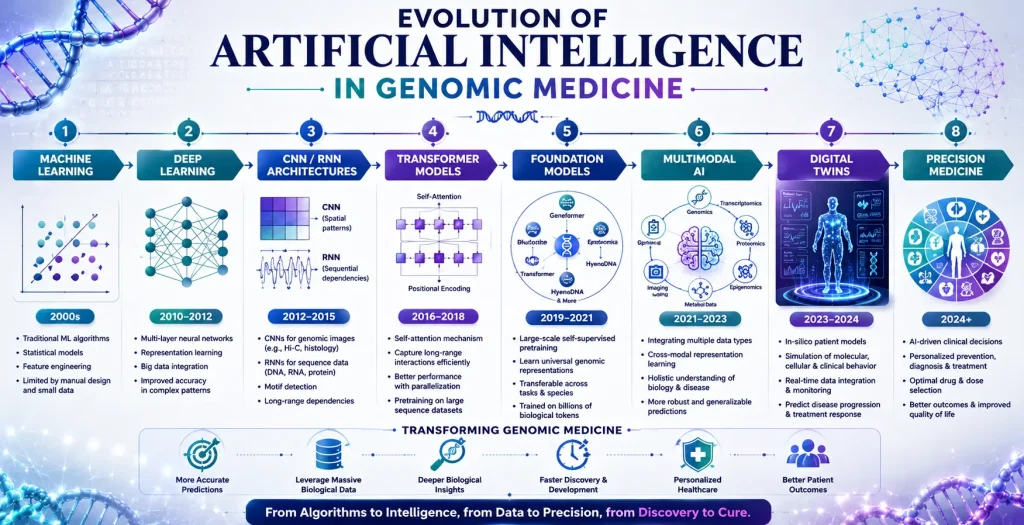
Evolution of AI in Genomic Medicine
How Well Does AI in Genomic Medicine Perform?
Artificial intelligence has demonstrated remarkable progress across multiple areas of genomic medicine, including variant interpretation, phenotype recognition, disease diagnosis, and clinical decision support (Stein et al., 2025; Li et al., 2026). Nevertheless, evaluating AI solely on impressive performance metrics provides an incomplete picture (Finlayson, 2026; O’Connor & McVeigh, 2025). The true measure of clinical value lies in whether these systems consistently improve diagnostic accuracy, reduce turnaround times, enhance patient outcomes, and perform reliably across diverse healthcare settings (Solomon, 2026; Changalidis et al., 2026).
Diagnostic Accuracy
One of the greatest strengths of AI in genomic medicine is its ability to analyze vast numbers of genetic variants rapidly while identifying those most likely to contribute to disease (Kim et al., 2024; Li et al., 2026). Machine learning and deep learning models can integrate information from population databases, evolutionary conservation, functional prediction algorithms, protein structure analyses, and published clinical evidence to prioritize pathogenic variants with remarkable efficiency (Stein et al., 2025; Changalidis et al., 2026).
Numerous studies have reported excellent discrimination between pathogenic and benign variants, with several AI models achieving area-under-the-curve (AUROC) values exceeding 0.90 during retrospective validation (Li et al., 2026; Stein et al., 2025). These findings demonstrate that AI can substantially reduce the analytical burden associated with whole-exome and whole-genome sequencing (Duong & Solomon, 2025; Everton et al., 2026).
Variant Prioritization
Variant prioritization represents one of the earliest and most successful applications of AI within clinical genomics (Kim et al., 2024; Stein et al., 2025). Conventional workflows often require experts to examine thousands of candidate variants manually before identifying the most plausible disease-causing mutation (Duong & Solomon, 2025; Li et al., 2026).
AI dramatically accelerates this process by ranking variants according to their predicted clinical relevance (Changalidis et al., 2026; Everton et al., 2026). Instead of reviewing an extensive list of possibilities, clinical geneticists receive a focused shortlist supported by computational evidence (Stein et al., 2025; Kim et al., 2024). This approach reduces interpretation time while improving analytical consistency across laboratories (Solomon, 2026; Advancing genome-based precision medicine, 2025).
Rare Disease Diagnosis
Rare genetic disorders frequently present substantial diagnostic challenges because affected individuals may exhibit complex or atypical clinical features (Ilić & Sarajlija, 2025; O’Connor & McVeigh, 2025). Artificial intelligence addresses this problem by simultaneously analyzing genomic variants, phenotype descriptions, family history, and biomedical literature to identify diseases that might otherwise remain undiagnosed (Solomon, 2026; Changalidis et al., 2026).
By integrating these diverse information sources, AI systems improve phenotype matching and facilitate recognition of uncommon disorders that conventional diagnostic approaches may overlook (Duong & Solomon, 2025; Everton et al., 2026). Several studies have shown that AI-assisted workflows can increase diagnostic yield while substantially reducing the time required to reach a molecular diagnosis (Stein et al., 2025; Li et al., 2026).
Improving Clinical Efficiency
Beyond diagnostic performance, AI delivers significant operational benefits throughout the genomic workflow (O’Connor & McVeigh, 2025; Advancing genome-based precision medicine, 2025). Tasks that previously required hours or even days of manual effort—including literature review, evidence synthesis, phenotype extraction, report drafting, and variant prioritization—can now be completed within minutes (Li et al., 2026; Everton et al., 2026).
These efficiency gains allow clinicians and laboratory scientists to devote more time to complex case evaluation, multidisciplinary consultation, and patient communication (Solomon, 2026; Duong & Solomon, 2025). As genomic testing volumes continue to increase, AI offers an important mechanism for maintaining diagnostic quality without proportionally increasing workforce demands (Changalidis et al., 2026; Kim et al., 2024).
Performance Across Diverse Populations
Although AI has achieved impressive results in research settings, model performance frequently declines when applied to populations that differ from those used during development (Ilić & Sarajlija, 2025; Duong & Solomon, 2025). Many existing genomic datasets predominantly represent individuals of European ancestry, limiting the generalizability of trained algorithms (Solomon, 2026; Advancing genome-based precision medicine, 2025).
This imbalance may reduce diagnostic accuracy for underrepresented populations and contribute to disparities in healthcare delivery (O’Connor & McVeigh, 2025; Finlayson, 2026). Improving dataset diversity has therefore become a major research priority (Al Souleiman & Al Souleiman, 2026; Changalidis et al., 2026).
FAQs of AI in Genomic Medicine
What is AI in genomic medicine and how does it work?
AI applies machine learning and language models to analyze genomic data. Specifically, these systems detect disease-causing variants. They also predict pathogenicity and support clinical decisions. Moreover, AI learns patterns from vast datasets. Ultimately, it accelerates analysis without replacing clinicians.
What are the main types of AI used in genomic medicine?
The six main types include machine learning and deep learning. Additionally, large language models review literature. Furthermore, computer vision recognizes facial phenotypes. Similarly, natural language processing extracts clinical notes. Finally, foundation models integrate multi-omics data. Each serves distinct purposes in clinical workflows.
How accurate is AI in genomic medicine?
AI shows promising accuracy in research settings. For instance, some models perform very well retrospectively. However, real-world performance varies across populations. Moreover, performance may degrade in diverse groups. Therefore, validate AI on local patient data. This ensures reliable clinical deployment.
Will AI replace clinical geneticists?
No. AI complements rather than replaces geneticists. Specifically, it handles variant prioritization efficiently. It also synthesizes evidence from literature. Meanwhile, clinicians provide biological interpretation. They also offer ethical oversight. Ultimately, combining AI with expertise yields optimal outcomes.
What is the difference between machine learning and deep learning?
Machine learning uses human-guided feature selection. In contrast, deep learning automatically learns from raw data. For example, machine learning prioritizes variants effectively. Meanwhile, deep learning excels at image analysis. It also recognizes DNA sequence patterns. However, deep learning requires more data but offers superior performance.
Clinical Pearls: Key Messages for Clinical Leaders
- AI augments—not replaces—clinical expertise. The most effective model combines computational efficiency with human judgment (Solomon, 2026).
- Data quality determines AI performance. High-quality, diverse, and well-annotated datasets are essential for reliable predictions (Duong & Solomon, 2025).
- Human oversight remains essential. Every AI-generated recommendation must be reviewed by qualified healthcare professionals (Finlayson, 2026).
- Foundation models represent the future. These systems can integrate multiple biomedical data types within a unified framework (Changalidis et al., 2026; Solomon, 2026).
- AI reduces manual workload. Tasks that previously required days can now be completed in minutes (Li et al., 2026; Everton et al., 2026).
Conclusion: Understanding AI Technologies in Genomic Medicine
Artificial intelligence offers powerful tools for genomic medicine. For example, it supports variant prioritization, phenotype recognition, clinical decision support, and precision therapeutics (Solomon, 2026; Changalidis et al., 2026). Therefore, understanding the core AI technologies is essential. These include machine learning, deep learning, large language models, computer vision, natural language processing, and foundation models. Furthermore, this knowledge helps select appropriate solutions for specific clinical challenges (Duong & Solomon, 2025; Kim et al., 2024).
Table 1 summarizes the strengths and limitations of each AI technology. Consequently, readers can compare their suitability for different genomic applications. Meanwhile, Table 3 demonstrates how these technologies integrate throughout the clinical workflow. In addition, Table 4 compares AI-assisted workflows with conventional approaches. Finally, Figure 2 illustrates how these technologies connect within the broader AI ecosystem in genomic medicine.
However, technological capability alone does not ensure successful implementation (O’Connor & McVeigh, 2025). Instead, organizations must establish strong governance frameworks. Moreover, they should ensure data integrity, regulatory compliance, privacy protection, and interoperability. Additionally, organizations must invest in workforce development and long-term sustainability (Al Souleiman & Al Souleiman, 2026; Advancing genome-based precision medicine, 2025).
In our next post, we will explore implementing AI in genomic medicine. Specifically, we will discuss the four-stage implementation framework, governance structures, regulatory navigation, and sustainable AI programs.
References
General & Foundational Reviews
- Solomon, B.D. Artificial intelligence in genomic medicine: dispelling three myths. npj Genom. Med. 11, 24 (2026). https://doi.org/10.1038/s41525-026-00575-y (Open Access)
- Duong, D., & Solomon, B. D. (2025). Artificial intelligence in clinical genetics. European Journal of Human Genetics, 33(3), 281-288. https://doi.org/10.1038/s41431-024-01782-w (Open Access)
- Dara, M., Dianatpour, M., Azarpira, N., & Tanideh, N. (2025). The transformative role of Artificial Intelligence in genomics: Opportunities and challenges. Gene Reports, 41, 102314. https://www.sciencedirect.com/science/article/abs/pii/S2452014425001876 (Requires Institutional Access)
Cancer Genomics & Precision Medicine
- O’Connor, O., & McVeigh, T. P. (2025). Increasing use of artificial intelligence in genomic medicine for cancer care- the promise and potential pitfalls. BJC Reports, 3, 20. https://doi.org/10.1038/s44276-025-00135-4 (Open Access)
- Syed Raza Abbas, Zeeshan Abbas, Arifa Zahir, Seung Won Lee, Advancing genome-based precision medicine: a review on machine learning applications for rare genetic disorders, Briefings in Bioinformatics, Volume 26, Issue 4, July 2025, bbaf329, https://doi.org/10.1093/bib/bbaf329 (Open Access)
Generative AI & Large Language Models (LLMs)
- Changalidis, A., Barbitoff, Y., Nasykhova, Y., & Glotov, A. (2026). A systematic review on the generative AI applications in human medical genetics. Frontiers in Genetics, 16, 1694070. https://doi.org/10.3389/fgene.2025.1694070 (Open Access)
- Li, W., Li, X., Lavallee, E. et al. From text to translation: using language models to prioritize variants for clinical review. Genome Med 18, 103 (2026). https://doi.org/10.1186/s13073-026-01661-7 (Open Access)
- Finlayson, S. G., & Rehm, H. L. (2026). When genomic reanalysis leaves the laboratory — clinical genetics in the age of consumer AI. NEJM AI, 3(7). https://doi.org/10.1056/aie2600766 (Requires Institutional Access)
Diagnostic Tools & Variant Interpretation
- Kim, H. H., Kim, D. W., Woo, J., & Lee, K. (2024). Explicable prioritization of genetic variants by integration of rule-based and machine learning algorithms for diagnosis of rare Mendelian disorders. Human Genomics, 18(1), 28. https://doi.org/10.1186/s40246-024-00595-8 (Open Access)
- Ilić, N., & Sarajlija, A. (2025). Artificial intelligence in the diagnosis of pediatric rare diseases: From real-world data toward a personalized medicine approach. Journal of Personalized Medicine, 15(9), 407. https://doi.org/10.3390/jpm15090407 (Open Access)
- Alsentzer, E., Li, M.M., Kobren, S.N. et al. Few shot learning for phenotype-driven diagnosis of patients with rare genetic diseases. npj Digit. Med. 8, 380 (2025). https://doi.org/10.1038/s41746-025-01749-1 (Open Access)
Advanced Modeling, Phenotyping & Integration
- Gurovich, Y., Hanani, Y., Bar, O. et al. Identifying facial phenotypes of genetic disorders using deep learning. Nat Med 25, 60–64 (2019). https://doi.org/10.1038/s41591-018-0279-0 (Requires Institutional Access)
- Stein, D., Kars, M.E., Milisavljevic, B. et al. Expanding the utility of variant effect predictions with phenotype-specific models. Nat Commun 16, 11113 (2025). https://doi.org/10.1038/s41467-025-66607-w (Open Access)
- Everton, Z., Botas, J., Kim, S. Y., Yao, L., Liu, Z., & Jeong, H. H. (2026). MARRVEL-MCP: An agentic interface for Mendelian disease discovery via tool-augmented context engineering. American Journal of Human Genetics, 113(6), 1194-1213. https://doi.org/10.1016/j.ajhg.2026.04.012 (Requires Institutional Access)
- Orenbuch, R., Shearer, C.A., Kollasch, A.W. et al. Proteome-wide model for human disease genetics. Nat Genet 57, 3165–3174 (2025). https://doi.org/10.1038/s41588-025-02400-1 (Open Access)
Editorial Policy
The Scholar Post is committed to evidence-based, clinically grounded content. All articles undergo peer review by subject matter experts and are supported by peer-reviewed literature. We disclose any conflicts of interest and welcome feedback from the clinical community.
About the Author
Dr. Niamat Khan is a genetics researcher with over 19 years of teaching and research experience at a public university in Pakistan. He specializes in rare inherited disorders and hereditary cancers, focusing on identifying pathogenic variants underlying neurodevelopmental disorders, retinal dystrophies, and inherited breast cancer in consanguineous populations using whole-exome sequencing and computational genomics. Dr. Khan is committed to advancing precision medicine through the integration of genomics and artificial intelligence in clinical diagnostics. For details profile Visit